
If you’ve ever found yourself scrolling through freelance writing job boards late at night, reading a job description that sounds interesting, and then immediately talking yourself out of applying, you’re not alone.
In fact, I think almost every freelance writer has asked themselves some version of this question at some point:
“Am I actually good enough to do this?”

I know I have.
What’s funny is that I’ve been freelance writing for more than a decade now.
Over that time I’ve worked with many brands, created courses and grown an audience that reads my blog psots and signs up to my newsletter (thanks so much!).
And when you look at me, it looks like I have it all put together and I should have left those doubts years ago.
But I do catch myself listening to the little voice in my head that screams doubtful things to me. It doesn’t happen often, but it still does occasionally.
The difference is that I don’t believe it anymore.
That voice was loud when I first started freelance writing. I was on maternity leave, taking care of my twins, and I knew I had to find a way to contribute financially but it was hard in the beginning.
I didn’t have a journalism degree. I didn’t have a portfolio filled with impressive client work. I didn’t know other freelance writers, and I didn’t have some master plan for building an online business.
What I did have was a desire to make this work. And, that’s about all I started with.
Every time I came across a writing job, I’d start comparing myself to imaginary writers who were seemed more qualified than I was. I assumed there was someone with more experience, better credentials, a stronger writing portfolio, and a much more professional-looking website waiting to apply for the same opportunity.
Sound familiar?
The truth is that most successful freelance writers didn’t start because they felt confident. For them they were able to start because they were willing to try even when feeling uncertain.
Now if you’re thinking maybe your’re not good enough, I want to stress that this doesn’t mean you aren’t qualified to be a freelance writer. What you’re feeling is that uncertainty when trying something new and that’s totally normal.
What Does “Good Enough” Even Mean?
I think one of the biggest problems with this question is that nobody knows what “good enough” is supposed to look like.
For some people, good enough means having an English degree. And for others, it could mean having years of experience in a specific niche or service. But realize that the goalposts will keep moving depending on who you’re comparing yourself to.e
Perhaps you’ve thought about these things:
I’ve never been gotten paid to write before. Am I cut out for this?
What if a client asks me a question I can’t answer? Am I a fraud then?
What if I choose the wrong niche and clients find out?
What if a client realizes I have no idea what I’m doing and doesn’t pay me?
What even is a semicolon and how do you use it?
I’ve had those thoughts too and you know what? I felt like a fraud when I landed my first client.
I felt like I hoodwinked them thinking they hired some expert writer, when in reality, they did but the writer didn’t belive it.
And then I would spirial and convince myself I’m not good enough and no one will hire me.
The problem is that we’re always comparing ourselves to writers who are years ahead of us instead of comparing ourselves to where we were six months ago.
We look at someone’s polished LinkedIn profile, their list of all their amazing clients, or their income reports and completely forget that they started somewhere too.
Nobody begins their freelance writing career as an expert in negotiating and landing client work.
Nobody.
The freelance writers you see today were once beginners just like you. They started on job boards like you and they also wondering if they will land a writing job.
For me, I’ve learned that clients aren’t concerned with perfection. Instead, they’re looking for writers that solve problems, communicates efficiently and follows the instructions given for content.
And you know what? Those are things you can LEARN…you can practice and eventually those will become second nature.
Why Almost Every Freelance Writer Feels Underqualified
One thing that surprised me was that confidence doesn’t magically arrive the moment you get your first client.
I assumed that once someone paid me for my writing, I’d feel like a real writer – the professional writer.
Then I landed my first client and felt nervous.
Later, when I landed higher-paying projects, I felt nervous again.
When bigger opportunities came along, I felt nervous then too.
Every new level seemed to come with its own set of doubts and questions.
What I’ve realized is that freelancing puts you in situations where you’re always learning new things. That’s actually part of the job.
Many of the writing jobs I’ve worked on over the years involved topics I knew very little about when I first accepted them. I’ve written about VFX, email segmentation, cybersecurity, WordPress, and countless other subjects.
Did I know everything about those industries before I started writing about them?
I researched. I asked questions. I read articles. I learned.
That’s what professional writers do.
The freelance writers who succeed aren’t the smartest people in the room or the ones with the most impressive credentials. More often than not, they’re willing to learn, willing to figure things out, and willing to keep going even when they don’t feel completely ready.
And that’s something you need to think about before you start down the path of freelance writing.
8 Signs You’re Already Ready to Start Freelance Writing
So, even if you have serious doubts about the capability of starting a freelance writing business, know that it IS POSSIBLE even if you’re a busy mom, even if you’re a college student and even if you just lost your job.
It’s possible because you already have these skills to be a freelance writer.
1. You Can Explain Things Clearly
A HUGE myth about freelance writing is that you have to be uber smart in what you’re writing about.
Not real and not true.
From experience, I know the highest-paying content is written in way that reads simply and conversationally.
And plus, many writers learn on the job and then never retain what they learned.
Try this –
If a friend of yours asked you how to make a certain recipe, you would give them the steps to make it right? It’s the same when teaching your child something new. You break down the concepts so it’s easier for your child to understand.
That’s what clients want form their writers. Oftentimes, the service or tool they have is difficult to explain and it’s our job to make it a easy to understand.
And they seek a writer that can explain their overly complicated tool in an easy-to-read manner.
And this means that even if you didn’t major in English or even like writing essays, you can still be a freelance writer.
When I went to college, I unfortunately got a C in English but you know what? Clients still hired me because they didn’t care about that. They just cared I can write in a way that’s easy-to-understand.
2. You Have Curiosity to Learn New Things
I was under the impresson that legit freelance writers knew EVERYTHING and ANYTHING about their niche topic.
I couldn’t have been more wrong.
The truth is that freelance writers spend a lot of time learning. We research. We read articles. We watch videos. We interview people. We ask questions. Then we take everything we’ve learned and turn it into content that helps readers.
Over the years, I’ve written about many topics around digital marketing but in the beginning I wasn’t an expert in those ideas before accepting gigs.
I learned as I went and that’s what writers do.
It’s the same when you pick up a new job as a secretary for example. You have to learn the software, the filing system, the schedules, and the preferences of the people you work with.
So if you’re naturally curious, enjoy learning new things, and don’t mind doing a little research, you’re already developing one of the most valuable skills a freelance writer can have.
3. You Finish What You Start
I don’t know about you, but I love starting something and taking the time to see the completion of. That’s why writing a blog post is still soo much fun and satisfying for me!
Many new freelance writers assume clients hire based solely on talent. While writing ability certainly matters, reliability matters (I think) a lot more.
Clients need content completed and deadlines met. This tells you they want a writer they can count on and that doesn’t ghost them when times are tough.
I’ve worked with business owners over the years and I know they’d rather work with solid freelance writers that hand over work consistently than a brilliant writer that dissapears for weeks at a time.
If you follow through on your commitments and takes deadlines seriously, you have the skill many freelancers struggle to devolop.
4. You’ve Been Writing Longer Than You Think
One of my favorite conversations to have with aspiring writers goes something like this:
“I don’t have any writing experience.“
Then I ask a few questions. Have you written:
- Blog posts?
- Social media content?
- Emails?
- School assignments?
- Press release for the company you work for?
- Personal projects?
- A journal?
- A community newsletter?
By the end of the conversation, we discover they’ve been writing for years.
The only difference is that nobody has paid them for it yet.
Now, does writing a school paper automatically qualify you for every freelance writing job? Of course not.
What it DOES mean is you already have experience with communicating your ideas through your writing. This is something you can keep refining as you grow your freelance writing business.
6. You Care About Doing Good Work
When I first started as a freelance writer, all I did for the longest time was LEARN about it so that I could create good work for clients.
And believe it or not, the fact that you’re reading an article like this is a positive sign.
It’s people like us – who actually CARE about quality work – who seems to question themselves more and also have a bit of imposter syndrome.
The things they question or worry about might be if they’re good enough or if they are providing value.
Meanwhile, for the people who could care less about quality don’t even question what they are doing.
But there aren’t that many of THOSE people what want to freelance write. Instead, there are many talented writers who often underestimate themselves because they care about what they are writing.
So, if you care that means you are doing your due diligence and learning to improve your craft and WANTING to form a strong freelance writing foundation.
7. You Have Thick Skin
Guess what? When you write for clients (and especially magazines/publications):
You’re going to receive edits.
I still receive edits from new clients and that’s okay!
After more than a decade of freelance writing, clients have asked for revisions, request changes, or want a different angle on a piece. I mean I don’t get them often but I do get them and they aren’t always productive.
For example, here’s an editor telling me they edited my work and to review it. This is a common type of communication you’ll get from an editor.
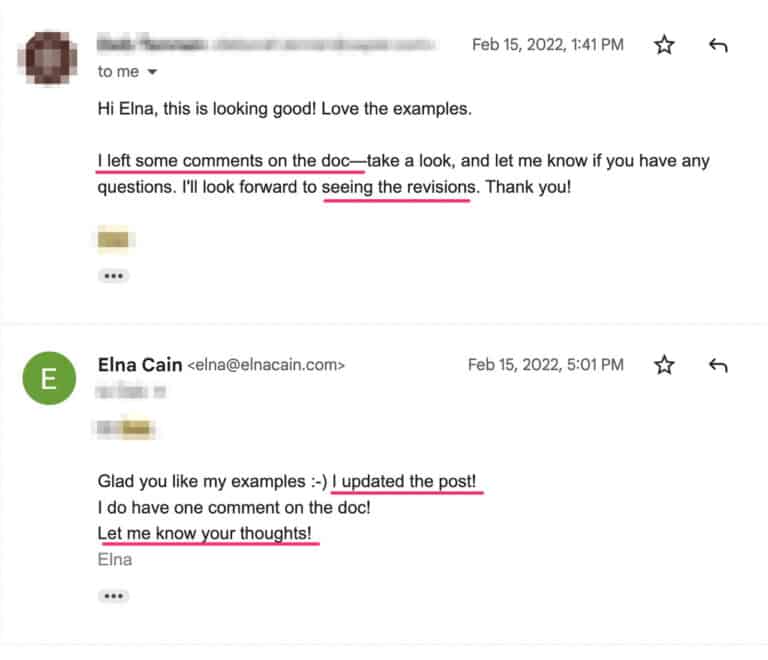
For new writers, feedback can sometimes feel personal. And sometimes you may take it that way.
I will “quit” writing jobs if I find that every time I submit a post, the editor will over edit or knit pick everything I write.
Here is a client I had back in the day telling me basically my post sucked and to re-write it. This ISN’T that common. In fact, this is the SECOND time I had this in the 10+ years of writing online.
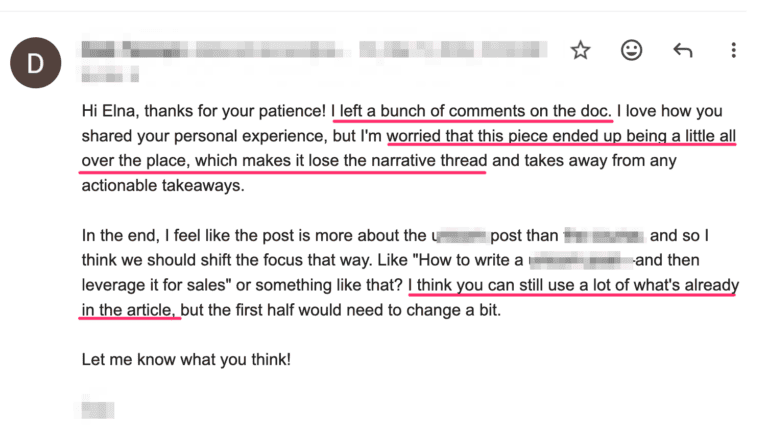
For me, I heavily guard my mental health and I don’t want to be talked down to or have my writing ripped apart.
Most of the time, though, editors will give you a compliment and then tell you they changed things up. They may ask you WHY you had that stat or example.
But realize that writing is a collaborative effort. Clients want the content you provide to impact their bottom line so feedback is important in getting it right.
Look, you will get feedback and the majority will be productive and something you can learn from. Occasionally you’ll get the editor from hell and it’s up to you if you want to put up with that or not. In either case, you need thick skin!
8. You’re Willing to Start Before You Feel Ready
This might be the most important sign of all on whether or not you’re ready to freelance writing.
Because if I’m being honest, I don’t know that I’ve ever felt completely ready for any major step in my business.
I always second guessed my pitches, stressed over landing my first client and had to “fake it until I made it” with negotiating my rates.
Yet every one of those decisions ended up helping me grow.
Looking back, anytime I was “ready” or for sure about taking a gig, it was AFTER taking action. So even though you’re worried and anxious to start freelance writing, AFTER you start you’ll feel more confident.
And realize that most of the confidence you want isn’t waiting for you at the beginning. It’s waiting for you on the other side of doing the thing that scares you.
What You Actually Need to Get Started
One of the reasons so many aspiring writers stay stuck is because they’ve convinced themselves they need a long list of qualifications before they can begin.
But for me, I didn’t have all those things to start. I had them while I was starting.
I didn’t build my portfolio until I had a few clips. I didn’t learn my niche until I wrote several articles about my niche. And also, the rate that I charge now isn’t the rate I started with. That took years to increase.
So when looking back to when I first started, I see I had very little to go by but I made it work.
What I did have was curiosity and the willingness to keep on learning. That gave me the courage to send my first pitch.
That’s where most freelance writing careers begin.
So, Are You Good Enough to Be a Freelance Writer?
Yes of course you are!
You may not feel completely confident yet and you may not have all the answers.
But that’s okay. You don’t need all of those things to start freelancing.
Just remember that every successful freelance writer you follow on LinkedIn or Instagram, was once in your shoes. They had to start also!
Now it’s your turn to just start!
Tell me in the comments if you want to start freelance writing but not sure how to start! I’d love to help you!

Leave a Reply