
Have you ever looked at another freelance writer and wondered, How are they getting all these writing jobs?
Because I have.
You see someone posting on LinkedIn about a new client, another project they just landed, or how they’re completely booked for the month.

Meanwhile, you’re refreshing your inbox wondering where everyone is finding these clients.Are they using newsletters? Job boards? Or are they just cold pitching?
Maybe they’are arent. Well, maybe they’re just a better writer than me.
But after freelance writing for over a decade, I don’t think that’s usually it.
I’ve been doing this long enough that I have the experience. I have the portfolio. I have the client work and reputation behind me. But one thing I’ve learned is that none of that automatically means freelance writing jobs will keep landing in your inbox forever.
The market changes. Clients change. The way companies hire writers changes.
And you have to change with it.
For me, that has meant paying much more attention to the things happening around the writing.
How am I positioning myself? Am I still visible to the people who could hire me? Am I nurturing the relationships I’ve built over the years?
And, probably most importantly, am I making it ridiculously easy for someone to understand what I do and refer me when an opportunity comes up?
So, in this post, let’s talk about why this is happening and how you can benefit from it.
Why Are Some Writers Landing Jobs and Others Aren’t?
I’ve seen plenty of amazing writers struggle to find consistent work.
The difference I’ve noticed is that the writers getting hired tend to stay on people’s radar. Clients know what they do.
Other writers know what they do. And when someone says, “Hey, do you know a writer who can help with this?” their name comes up.And that’s what I’ve been focussing on lately.
Not doing more for the sake of doing more. Not jumping on every platform or chasing every freelance writing job I see.
I’m focusing harder on the things that are already working for me—and, surprisingly, freelance writing has started feeling a lot more fun and a lot less like a job because of it.
Okay, let’s see what is happening right now so that you can be prepared and ready.
1. Being a Good Writer Isn’t Enough Anymore
You can be a really good writer and still struggle to find work.I learned this last year when I was struggling to land one more client.
I already had clients and I thought my skills were enough….nope…they weren’t.
You can have years of experience, a nice portfolio, testimonials and published samples and still go through a dry spell where you’re wondering, Okay…where did all the clients go?
I’ve been freelance writing for over a decade and I’m at the point where I have the experience behind me. I’ve worked with brands I once would have dreamed about writing for. I have the samples. I have the reputation.
But that doesn’t mean I can sit back and assume freelance writing jobs will keep showing up forever.
I’ve learned that writing and getting hired to write are two different skills.
And as the freelance writing market changes, I think that distinction matters even more. So, being able to write a great article gets you rehired.
But making sure people know you exist in the first place gets you considered. So when I mentioned I had a dry spell, I had to change my view and focus on the acequisiton part, not the writing part.
Clients need to be able to find me, right?
2. Can Someone Tell What You Do in About 10 Seconds?
If someone landed on your LinkedIn profile or freelance writer website right now, would they know what you do?
Not after reading your entire About page and clicking through six portfolio samples. I’m talking about almost immediately.
- What do you write?
- Who do you write for?
- What are you really good at?
I’ve changed my services many times since I first started freelance writing. The type of writing I did when I was a brand new writer isn’t necessarily what I want to be hired for now.
And that’s normal.
Your freelance writing business should change as you get better, figure out what you enjoy and see where the demand is going.
But sometimes our positioning gets stuck three years behind us. I’m in the process of updating my service website (well my husband is in charge of that and it’s taking him a looong time…) because I want to highlight the new skills and services I am offering.
Maybe your website still talks about services you don’t really want to offer anymore. Or your LinkedIn headline is so broad that you could write for practically anyone.
I’ve found that the clearer I am about what I do, the easier it is for someone else to understand where I fit.
So this means having a solid freelance writer title for every social platform you have and any author bio you publish.
3. Your Reputation Can’t Help You If Nobody Sees You
I’ve already spent years building my reputation as a freelance writer but I’ve realized that having a reputation and being visible are two different things.
I could have the best portfolio in the world sitting on my website, but if nobody is visiting that website, what is it really doing for me?
The same goes for your old client work.
You might have written hundreds of articles. You might have worked with some amazing brands. You might have testimonials telling everyone how wonderful you are to work with.
That’s all valuable. But people are busy.
They aren’t sitting around thinking about the freelance writer they worked with three years ago.
You have to give them little reminders that you’re still here.
For me, that’s meant showing up more with my own content. I’m sharing what I know about freelance writing, talking about what’s changing in content marketing and putting my thoughts out there instead of keeping everything tucked away in my Google Docs.
I’m not doing that because I need to prove I’m a writer. At this point, I don’t.
I’m doing it because I want to stay on people’s radar. There’s a difference.
And for you, you can do this on LinkedIn. I get inquires for writing jobs on LinkedIn all the time so I know that I’ve created a highly optimzied profile so that clients can find me.
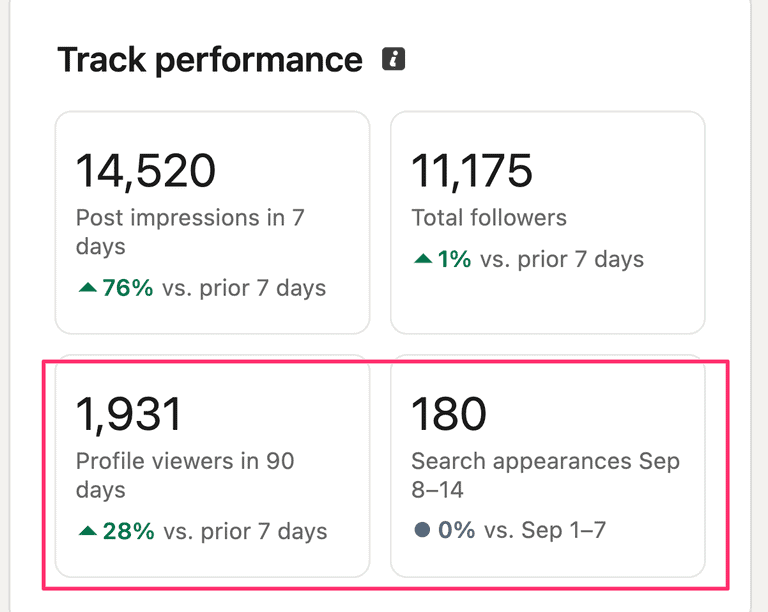
You can see with my LinkedIn analtyics that my profile views have increased and that my searches haven’t but with time I hope it will.
4. Don’t Only Show Up When You Need a Client
I see this happen all the time. A writer gets busy with client work and disappears.
Which I completely understand because I’ve done it too!
When you have deadlines, emails, revisions and client calls, posting on LinkedIn or updating your own blog can quickly move to the bottom of the list.
Then one client ends and another cuts their content budget.
Suddenly you have a giant hole in your schedule and you’re back online saying:
Hey everyone! I have availability!
There’s nothing wrong with letting people know you’re available. But it’s a lot easier to do that when you haven’t been completely silent for the last six months.
And it’s like you don’t have to post every day or even turn yourself into a “content creator” like me.
The whole point is to just stay in the conversation.
Go ahead and share something you’ve learned from a project. Talk about something happening in your industry. Leave thoughtful comments on other people’s posts. Share your opinion on where content is going.
That way, when you do have an opening, you’re not reintroducing yourself to everyone.
They already know you’re there.
This is something I’m still working on because I do get immersed in my client work and will “disappear” from LinkedIn for weeks or months at a time.
5. Relationships Matter More Than I Realized
When I first started freelance writing, I was very focused on getting the client. I didn’t care about anything else. I had to find a job or send a cold pitch so that I wold get hired. And once I was hired and paid, I’d start all over again.
And that works when you’re starting out because you need those first few clients.
But the longer I’ve been a freelance writer, the more I’ve realized how much of this business is built on relationships and networking.
People move around or an editor you worked with years ago might end up at another company.
A content marketer might remember you when their new company suddenly needs a writer.
A freelance writer you talked to on LinkedIn might recommend you for something they don’t have time to take on.
A past client might come back two years later with a completely different project.
You never really know where the next opportunity is going to come from. And this doesn’t mean you have to “network” all day.
I’m an introvert. The idea of networking for the sake of networking has never appealed to me. I’d rather have genuine conversations with people, support what they’re doing and stay in touch.
That’s enough.
Just make sure and don’t disappear the second a project is over.
6. Make Yourself Really Easy to Refer

This is one of those small things that can make a BIG difference. Make it easy for someone to explain what you do.
Because referrals don’t usually sound like this:
“I know a highly skilled freelance content professional with extensive experience creating strategic digital assets across multiple verticals.”
No one talks like that.
They say:
“Oh! I know a SaaS writer.”
Or:
“I know someone who’s really good at interviewing experts for articles.”
That’s why positioning matters so much.
The clearer you are about what you do, the easier it is for someone else to remember you when the right opportunity comes up.
Ideally, someone should be able to refer you without pulling up your website to remember what services you offer.
You want them to think of your name almost immediately.
And how do you become an easy person to refer to?
You need to schmooze your way to it! It’s hard as an introvert but I try to connect with potential clients or people that hire writers every day.
I also may talk abou tthem in a blog post or write about them on a LinkedIn post.
I want to get on the radar of these people and to do that, you have to be in their face at times.
If that seems undobale, then write about your process for client work on LinkedIn. Or guest post so that you are working with an editor (who might end up hirin you).
7. Doing More Doesn’t Always Get You More Work
When freelance writing gets slow, our first instinct is usually to do MORE.
I know I tend to do this. I will apply to more freelance writing jobs and just post more overall.
I may update my website (i.e. what I’m doing RIGHT NOW) or write more blog posts (like RIGHT NOW).
Before you know it, you’re spending more time trying to find freelance writing work than actually writing.
And I don’t think that’s always the answer.
This year, I’ve been paying much closer attention to what’s already working for me. I’m also focussing on where the people are engaging so I can be included.
I look to offer a new service as a way to gain more views on my profile or search opportunites.
I’d rather double down on something that’s already showing signs of working than constantly start over with another client-getting strategy.
And I’ve found that approach much more enjoyable too.
It feels less like I’m chasing work and more like I’m building on what I’ve already created.
So, Why Are They Getting the Freelance Writing Jobs?

The next time you see another freelance writer announce a new client, remember that you’re only seeing the end result.
You don’t see the LinkedIn post they wrote three months ago that caught someone’s attention. And you don’t see the old client who referred them.
And you definitely don’t know that they’re a better writer than you.
They might simply be easier to remember when someone needs a writer.
That’s something we can actually work on. Get clear about what you want to be hired for.
Keep showing up even when you’re busy and build relationships without expecting something from every single one.
Those actionable things will make it easy for people to understand what you do and tell someone else about you.
So it’s more about building that reputaiotn, fostering connections and improving your skillset!
What are you waiting for!



Leave a Reply