Is freelance writing really changing for 2026? What are your predicitons?
I’ve been at this for over a decade and I can definitely say that content looks different than when I first started.
Back then, businesses were still trying to figure out blogging.
Many companies weren’t publishing content consistently.
AI writing tools didn’t exist.
LinkedIn wasn’t overflowing with thought leadership posts.
And really, getting freelance writing work felt much simpler in some ways.
Over the last few years especially, I’ve watched the content landscape change faster than I ever expected.
And now we’re all navigating a world where AI can generate content in seconds.
A lot of writers are wondering what freelance writing will even look like now and in the future.
The good news?
Businesses still need writers.
But the role of freelance writers is changing for the better.
Let’s look at the biggest freelance writing trends and predeicitons shaping 2026 and what they mean for your freelance business.
AI Isn’t Replacing Great Writers — It’s Raising the Bar
I’m sure you’re bored with the AI conversation all over LinkedIn but it’s a legit concern for new (and old) freelance writers.
Many writers worry AI will completely replace content writing jobs. And you know what? It has replaced some writers but not all.
I’ve been freelance writing for 12 years, and I’ve never seen technology change the content industry this quickly.
But after watching clients, marketers, and businesses adapt over the last few years, I’ve noticed something interesting happening.
AI hasn’t eliminated the need for writers.
It’s changing what clients are willing to pay for.
According to an Upwork Research Institute report, 71% of freelancers using AI say they’re using it to improve and support their work rather than replace it entirely.
That statistic tells me that AI is becoming another tool in a writer’s toolbox, much like grammar software or keyword research tools.
The real challenge for businesses isn’t generating content anymore.
It’s generating content that stands out.
Any marketer or writer can ask ChatGPT to spit out a blog post.
Instead of asking it to write the whole post, use it as an assistant to find examples and quotes for you. Of course you have to do most of the legwork with interviewing experts or developing a unique point of view.
I’ve noticed this shift with my own clients.
The conversations aren’t centered around word count anymore.
They’re asking questions about content strategy, search intent, customer pain points, messaging, and conversions.
Those are skills AI can’t replicate on its own.
And that’s why I believe the writers who continue developing strategic and creative skills will have a huge advantage in 2026.
AI Will Probably Be More Expensive Down the Road
Right now, it’s hard to imagine that AI will be more expensive than it is now but as demand grows, prices will increase. And when a low-cost solution isn’t low-cost anymore, you stop using that tools or service.
And this is already happening. OpenAi is reporting a loss of $14 billion for 2026.
When AI companies are bleeding money like this, it’s likely the AI bubble will pop and things will go back to becoming more normal.
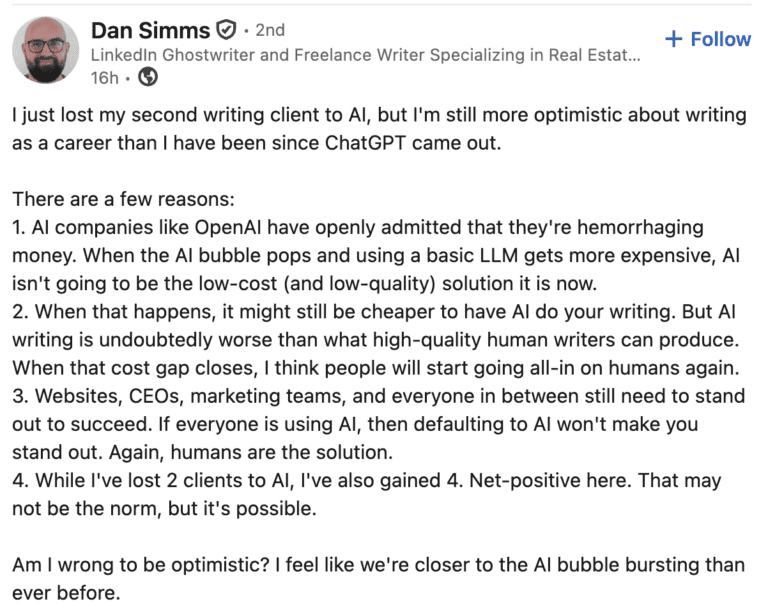
But that’s not to say you won’t lose a job to AI. Ghostwriter Dan Sims just lost a job to AI but he’s still highly optimistic.
His reasons to be optmistic are:
1. AI companies like OpenAI have openly admitted that they’re hemorrhaging money. When the AI bubble pops and using a basic LLM gets more expensive, AI isn’t going to be the low-cost (and low-quality) solution it is now. 2. When that happens, it might still be cheaper to have AI do your writing. But AI writing is undoubtedly worse than what high-quality human writers can produce. When that cost gap closes, I think people will start going all-in on humans again. 3. Websites, CEOs, marketing teams, and everyone in between still need to stand out to succeed. If everyone is using AI, then defaulting to AI won’t make you stand out. Again, humans are the solution. 4. While I’ve lost 2 clients to AI, I’ve also gained 4. Net-positive here. That may not be the norm, but it’s possible.
This viewpoint is growing too.
Many people view this as when we had COVID and companies shut down. Marketing consultant Linsey Knerl says, “Not wrong. It feels very much like COVID times when I saw many of my travel, senior living, and entertainment clients go away. But the world eventually righted itself.”
And I’m already seeing this trend right now. Just the other day one of my subscriptions for jobs sent out a long list of freelance jobs AND I’ve been seeing much more jobs on LinkedIn than ever before.
Thought Leadership Content Continues to Grow
One of the biggest shifts I’ve noticed over the last few years is the growing demand for thought leadership content.
Many executives, founders, consultants, and SaaS companies want content that showcases expertise and will use LinkedIn to share those ideas.
MarketingProfs found that 47% of B2B marketers plan to increase their use of original research and data-driven thought leadership content in 2026.
I’ve noticed more companies looking for writers who can help create expert-driven content instead of generic blog posts.
That’s creating opportunities in ghostwriting, LinkedIn content, newsletters, founder content, and industry commentary.
The challenge is that most of these professionals don’t have time to consistently create content themselves.
That’s where freelance writers are stepping in. So don’t be discourage that AI is taking away our writing jobs.
It’s not!
Businesses Are Prioritizing Content Quality Over Content Volume
A few years ago, many companies were publishing content at an incredible pace.
The goal was often to create as much content as possible. They did this because AI just flooded the market and business wanted to see its capabilities.
The writers who stand out are often the ones who bring ideas, strategy, and expertise to the table.
I’ve seen this happen in my own business.
Over the years, clients have asked me about content planning, topic selection, writer hiring and more.
Having these discussions creates longer relationships and higher-paying projects.
In 2026 and beyond, I believe businesses will continue looking for freelance writers who can think beyond the article itself and contribute to larger business goals.
When I started freelance writing, many writers operated almost completely behind the scenes. Some were on social media but many weren’t.
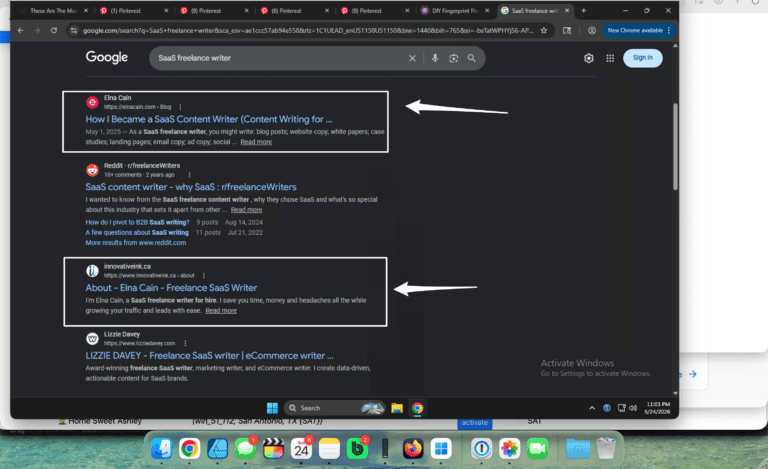
Today, clients are Googling writers before they hire them.
They’re checking your LinkedIn profile and they’re reading your blog posts. They may even search to see if you are on YouTube or on Instargram and TikTok.
Prospects nowadays are evaluating expertise before reaching out and that’s a good thing for you!
Building a personal brand has become one of the most powerful ways to attract clients and is the foundation of my program Writeto1k.
This is how I built my freelance writing business and it has paid off BIG TIME.
My blog, YouTube channel, LinkedIn content, email list, and website have generated opportunities that cold pitching alone never could.
The writers who consistently show their expertise online are often the ones getting noticed.
Do you have to do ALL THE THINGS like I did to build a brand?
No. What I would do is start with a LinkedIn profile, a writer website and one social profile on X, Instagram or TikTok.
Human Creativity Is Becoming a Competitive Advantage
One of the most interesting trends emerging frm the AI era is that businesses are actively looking for originality.
Research highlighted by TechRadar found a growing demand for writers, designers, and creative professionals as companies become frustrated with generic AI-generated content. Communications-related freelance jobs grew more than 25% in one recent analysis.
Clients and readers are becoming more aware of what generic content looks like.
This is why personal stories, unique experiences, original examples, interviews, expert insights, and strong opinions are becoming increasingly valuable.
AI can generate information but it’s YOUR point of view, YOUR experiences and what WAY you write that makes you a high paying freelance writer.
So remember that when you are struggling to find freelance writing jobs. You are NOT a commodity but a valuable asset!
If there’s one thing I’ve learned after 12 years of freelance writing, it’s that this industry never stays the same for very long.
The writers who succeed are usually the ones who adapt. Unfortunately I know of some freelancers who threw in the towel and decided NOT to continue.
And that’s hard for me to grapple with because over the years I had to adapt (but I also WANTED to).
I’ve adapted through content mills, algorithm updates, social media changes and now, AI, AI, AI.
And through all of this, there are still writing gigs to be had.
In fact, the freelance industry continues to grow. Upwork reports that freelance participation is expected to keep increasing, with projections showing freelancers eventually making up more than half of the U.S. workforce.
While technology continues to change, businesses will always need people who know how to connect with other people through words.
Freelance Writing Trends to Pay Attention To
I hope you’re still interested in freelance writing! I know every year that passes, I get giddy and excited for what’s to come.
I know changes will always happen but I look forward to that and I hope you do to!
Tell me in the comments what trends you’re noticing. I’d love to hear them.







Leave a Reply