
If you think like me, job boards probably feel like the easiest place to get started.
You may or may not create a job board profile, upload some samples, apply to a few jobs, and hope someone replies back.
That’s exactly what I did when I first started freelance writing during my maternity leave.

I thought success came down to applying to enough writing jobs until eventually someone gave me a chance.
And yes, job boards can help you land your first client.
But in 2026, they can also quietly keep you stuck in beginner mode if you aren’t using them strategically.
Because freelance writing has changed a lot. A LOT since I started a decade ago!
AI tools can now generate decent first drafts in seconds and businesses are publishing more content than ever.
Yet, clients are overwhelmed with applications and job boards are flooded with freelance writers competing for the same opportunities.
This is what’s been going on with a lot of new freelance writers.
They spend hours applying to jobs every day but never build anything outside the platforms. When that happens they have no authority or personal brand.
Then after months of applying, they start wondering if freelance writing is even worth it anymore.
So if you’ve been relying heavily on job boards to find freelance writing work, here are the biggest mistakes writers are making and what to focus on instead if you actually want long-term clients and higher-paying opportunitiess.
1. Treating Job Boards As a Lazy Activity
The biggest mistake new freelance writers make is treating job boards as a casual look through on a Sunday morning while sipping coffee.
That’s the wrong approach. Instead, treat it like a sprint. This is what content marketer Ashely Cummings said on a recent LinkedIn post.
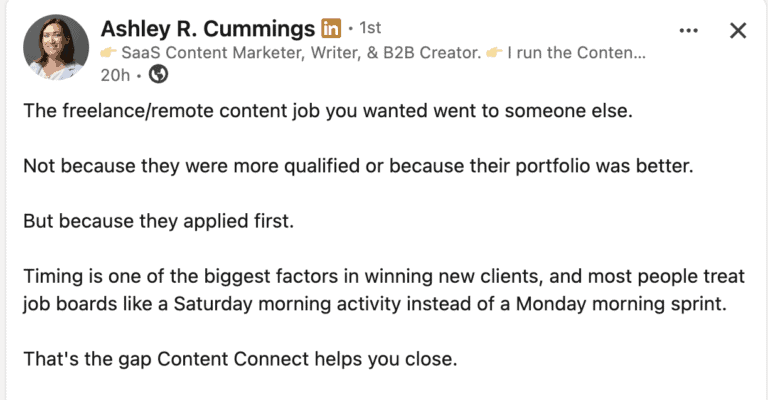
“The freelance/remote content job you wanted went to someone else. Not because they were more qualified or because their portfolio was better. But because they applied first. Timing is one of the biggest factors in winning new clients, and most people treat job boards like a Saturday morning activity instead of a Monday morning sprint.“
When you do this, you’ll be able to see any new writing jobs that pop up BEFORE your competition. That’s why I always suggest to check job boards in the morning and at night.
2. Applying to Every Writing Job You See
One of the things I did (and have taught) is to apply to every and any writing job you see.
Back in the day, it was normal for a freelance writer to have clients in all different industries and niches. I had a meal prep client and a dentist and VFX client!
But when you apply to every writing job you see, your writing portfolio and pitches can start looking scattered.
One day you’re applying for a beauty writing job. The next day it’s health writing. Then next week it’s pet blogs and legal content.
And really, clients notice this.
Businesses today are looking for freelance writers that understand their industry inside and out, the audience and type of customer for their niche.
A SaaS company wants a writer who understands software and marketing. An eCommerce brand wants someone familiar with online shopping behavior and conversions. A finance company wants someone who sounds trustworthy and accurate.
So when clients look at your writing samples and see completely unrelated topics with no clear direction, it becomes harder for them to picture you writing for their business specifically.
This is why applying to every single job posting usually doesn’t work as well long term.
What ends up happening is you spread yourself too thin instead of trying to build expertise in the areas that can really help yo ustand out.
And standing out is BIG right now. More and more businesses are overwhelmed with applications and AI-content.
The freelance writers getting noticed now are usually the ones with a personal brand, recognizable expertise around certain industry or types of writing (like copywriting).
That doesn’t mean you can never write outside your niche.
It just means that focusing on a few related areas helps clients trust you faster and makes your positioning much stronger over time.
3. Treating Job Boards Like Your Entire Business Strategy
Job boards can still help you land freelance writing gigs.
But they should not be your entire freelance writing strategy anymore.
This is something I wish I understood earlier because job boards are more competitive than ever now.
Some listings get hundreds of applications within an hour because AI tools allow writers to mass apply to jobs quickly.
This leave clients overwhelmed because a lot of businesses are receiving endless generic pitches written partially or fully by AI.
And because of that, standing out on job boards alone is becoming harder every year.
This is why relying only on platforms is risky for new freelance writers and why in my program Writeto1k.com I teach you almost 100 different ways to find clients.
You’re constantly competing in crowded spaces where clients have too many options and very little time.
What changed for me was realizing job boards worked best when you’re starting out and not as a permeant way to find gigs. Don’t get me wrong, job boards helped me learn how to pitch to clients, improve my writing and figure out which writing niches paid better.
But eventually I realized I needed lead sources that didn’t depend on competing with hundreds of freelance writers every single day.
That’s when I started focusing more on building assets online. I started creating SEO blog posts, posting consistently on LinkedIn, growing an email list, publishing YouTube videos, guest posting on other sites, and building my own authority online.
And this matters so much more in now because discoverability is becoming a huge advantage.
A blog post can rank for years. A YouTube video can bring inbound leads months later. A LinkedIn post can attract a founder who needs content help.
That’s how freelance writers slowly stop chasing clients all day long. Instead, they create systems where clients start finding them too.
And that means you don’t need job boards years later as a freelance writer.
4. Sending Generic AI-Assisted Pitches
Most job board pitches sound identical now. Clients are seeing endless applications filled with robotic language like:
“I’m passionate about writing.”
“I can deliver high-quality content.”
“I would love the opportunity to work with you.”
A lot of businesses can immediately tell when a pitch was heavily generated by AI. And this is becoming a huge issue in 2026 because clients are craving human communication again.
That doesn’t mean you can’t use AI tools. I use AI as a freelance writer!
But there’s a huge difference between using AI as an assistant versus letting it completely replace your thinking and personality.
The freelance writers standing out right now are the ones adding personal insight, strategy, creativity, and real observations.
One thing that helped me land more responses to job ads was slowing down and making my pitches feel more human. You don’t need a massive cover letter.
But referencing something specific about the business instantly changes the tone of your application.
Maybe you mention a blog post they published recently, a content gap you noticed, their email newsletter, their SEO strategy, or even an article idea you think could perform well.
That instantly separates you from writers blindly copy-pasting applications.
And businesses notice the difference.
5. Ignoring SEO and Content Strategy
A lot of freelance writers still think businesses are hiring them “just to write” on their company blog.
But that’s usually not enough anymore and if you want to win that writing job, then make sure you understand SEO.
Businesses who have a content strategy are interested about traffic, conversions, email signups, sales, and brand authority.
The good news is you do not need to become a technical SEO expert.
But learning basic SEO concepts gives you a huge advantage over writers who only focus on wording.
Understanding search intent, content structure, keyword placement, topical authority, internal linking, and headline optimization can completely change how clients see your value.
For more help on writing SEO for clients, check out my masterclass Fast Track to SEO Writing.

And AI makes this even more important.
Because if AI can already produce decent generic writing, businesses are looking for writers who understand why content exists and how it supports business goals.
That’s the real value now, especially in SaaS, eCommerce, B2B, affiliate marketing, and service-based businesses where content directly connects to revenue.
Even changing how you describe your services helps.
So, instead of saying:
“I write blog posts.”
You can start saying:
“I help businesses create SEO-focused content designed to attract qualified traffic and support conversions.”
That’s a completely different level of positioning and can help you land writing jobs quicker.
6. Spending More Time Learning Than Taking Action
This one is becoming even more common nowadays because there’s so much content online now for freelance writings to know.
You can spend all day watching YouTube videos about freelance writing, AI tools, SEO, personal branding, productivity systems, and client acquisition.
It feels productive, right?
But meanwhile, no actual pitches are getting sent.
I see new freelance writers constantly stuck in preparation mode and don’t get me wrong, when I’m not writing for clients, I can spend an hour or more just scrolling on LinkedIn or YouTube thinking I’m, “just finding sources for my writing” when I’m not really!
But, you rarely feel fully ready. Fear is usually the real issue.
- Fear of rejection
- Fear of sounding inexperienced
- Fear of not being good enough
- Fear of clients ignoring you
And, that part never fully disappears.
Even experienced freelance writers still deal with rejection sometimes (I still do!).
But momentum only happens when you start taking action consistently.
Your first few pitches probably won’t be amazing (mine definitely weren’t!).
But freelance writing is one of those careers where improvement happens through real-world experience.
So, take that leap and start sourcing gigs on job boards and make it a habit.
7. Not Following Directions Carefully
Clients pay attention to details more than ever now.
Especially now when businesses are flooded with low-effort AI-generated applications from their job ad.
So if a job post asks for two samples and your rates, and you ignore half the instructions, that immediately creates doubt…Uh, oh, red flag!
Because from the client’s perspective, they’re thinking:
“If this writer doesn’t follow directions during the application process, will they follow directions while working on assignments?”
A lot of businesses intentionally include small instructions to filter applicants quickly.
One of my first pitches to a writing job asked to include the word “lucky charms” in my email subject line. That instruction was buried in a paragraph towards the end of the write up.
You can imaging how many people NEVER saw that because they NEVER read the ENTIRE job ad!
So, before submitting a pitch, slow down.
Other common pitching mistakes you may make are:
- Using the wrong contact name
- Spelling the business name wrong (one of my clients is beehiiv, not Beehiiv, not Beehive, and not Bee Hive)
- Having grammar errors
Read the listing carefully again. Proofread your application. Make sure your links work properly. Double-check attachments.
Small details make a bigger difference than most writers realize.
8. Staying on Job Boards Too Long
Job boards are helpful when you’re building momentum, but eventually, you want to build something bigger than constantly applying for gigs every day.
Because in 2026, the freelance writers growing the fastest are usually the ones building authority online.
They’re
- creating content consistently
- posting on LinkedIn
- building email lists
- showing expertise publicly
- sharing opinions and insights
- creating YouTube videos
- building personal brands
And, this matters even more now because AI is changing how businesses choose writers. Cheap, generic writing is becoming easier to replace.
But businesses still need freelance writers who can think strategically, understand audiences, communicate clearly, build trust, add personality, and create original ideas.
That’s where human writers still stand out. Especially writers who become known for something specific.
So yes, use job boards, but don’t stop there.
To succeed you want to grow your freelance business, right? And to do that is to eventually transition away form job boards and start using cold emailing and networking.
9. Relying Too Much on AI to Do the Thinking
And really, they can be incredibly helpful for freelance writers. I mean, they are for me.
I use AI to brainstorm article ideas, add unique sources, organize messy thoughts, summarize research, and even speed up editing.
But one mistake I’m seeing more writers make now is relying on AI so heavily that they stop developing their own thinking skills.
And clients can tell.
A lot of content online is starting to sound exactly the same because everyone is pulling from the same tools and similar prompts.
The structure feels predictable, and the phrasing feels robotic. When you read AI generated content, the ideas feel surface-level.
This is becoming a huge problem because businesses are drowning in generic AI content now.
That means original thinking is becoming more valuable and that’s where you can come in and make a name for yourself.
The writers standing out in the world of AI are the ones adding:
- Real observations
- Personal experience
- Industry insights
- Unique examples
- Strong opinions
- Strategic thinking
This is why I always tell freelance writers to treat AI like an assistant, not a replacement for their brain.
Use it to support your workflow, but be responsible to research deeply.
- Still form your own opinions
- Still analyze what competitors are doing
- Still study audiences
- Still improve your writing intentionally
Because your ability to think critically and communicate clearly is what will separates you from generic content.
And businesses are starting to pay a premium for that again which is a good thing for us!
10. Not Building a Personal Brand Early Enough
A lot of new freelance writers still believe they can stay completely invisible online and somehow build a thriving business long term.
And while that was a little easier years ago, nowadays it’s different.
Businesses want trust signals now and they want to Google you or check you out on LinkedIn.
For me, if a client wants a SaaS content writer, they can easily find me on Google either from the blog post I wrote about SaaS writing on this blog or my service-based website, Innovative Ink.
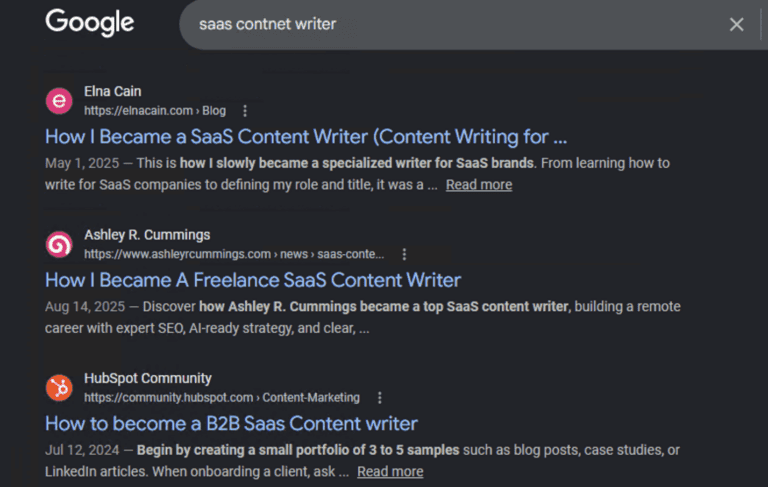
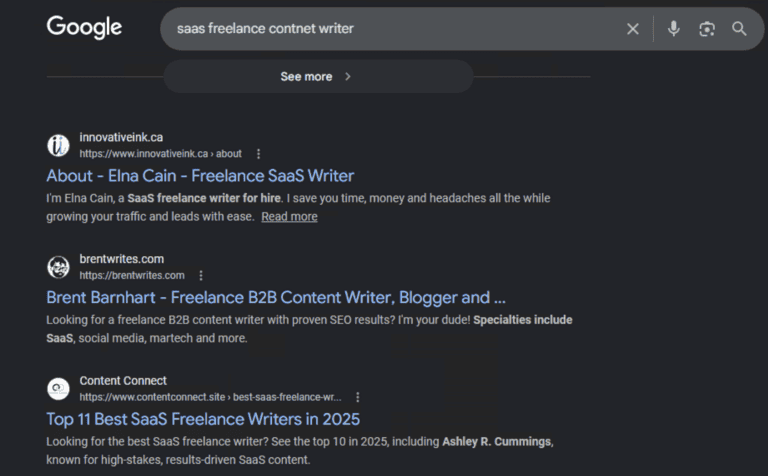
Clients will also want to see your website when they search your name.
They want proof that you understand your writing niche and know how to communicate online.
This is why building a personal brand matters so much now.
And no, that doesn’t mean becoming some huge influencer or even a content creator like myself.
You don’t need millions of followers; You just need visibility.
That could mean getting onto social media and building a following.
Or, it could mean writing SEO blog posts on your website or on Medium.
It’s also a good idea to post regularly on LinkedIn. This is difficult, especially for me, but it does make you much more visible on LinkedIn.
Over time, all of those things create authority. And authority changes how clients see you.
Instead of looking like another random content writer applying to gigs, you start looking like someone who actually understands the industry.
This is one reason personal branding has become such a massive advantage for freelance writers when using job boards.
No More Job Board Mistakes!
I hope you aren’t doing any of these job board mistakes as a new freelance writer! But if you are, know that you can easily fix them today!
Tell me in the comments how you will approach job boards after reading this post!
I’d love to hear it.


Leave a Reply