
When I saw Karolina Assi’s post on LinkedIn, I was a bit surprised but not really though.
“Being a content writer means learning about a topic you have no idea about within a few hours, writing about it, and then forgetting everything you learned as soon as you submit the content piece.”
For the new budding freelance writer, this is entire job description in one sentence.

But what was surprising to me were the comments because every writer just nodded and said, “Yep, that’s me too.”
I don’t know about you, but I don’t want to live like this as a content writer.
Do you? Always having to spend 10+ hours researching a topic before you write it?
That was me at the start.
I didn’t realize that content writers feel this is necessary.
And that’s why I encourage freelance writers to niche down or find a writing niche that they can write about for many years to come.
This will help you don’t get “research fatigue” when there’s a no topic to write about.
For me, I am comfortable writing about social media platforms and digital marketing tactics.
Anything outside of that (like WordPress or even some email marketing concepts), it does take me longer.
Below, I’ll share what they feel about having to write and forget a topic over and over again.
As a Beginner Content Writer
For about five years of freelance writing, I was getting a lot of fatigue researching new topics.
I was still learning my niche – digital marketing – so I would spend about 60% of time researching and the rest writing and editing.
After the five-year mark, things started to calm down and I knew a lot about my niche. I was confident to pick up an ESP client or a AI client.
I’m still hesitant to go “full-force” into finding SEO clients or ESP clients because I know I need more time for the technical stuff and for research.
So, if you’re new to content writing, then maybe these quotes can help you either “love” this skill or want to niche down!
1. Content Writers Live in a Constant State of Crash-Course Learning
Copywriters and content writers don’t have the luxury of slow learning. They don’t get three months to understand an industry.
They get a week.
Sometimes only a day.
And sometimes two hours before a kickoff call.
And they make it work because:
- they know how to research fast
- they know where to look
- they know how to separate useful information from noise
- they know how to write clearly even when a topic is new
Shahrukh Jadoon said it perfectly:

“The worst part is preparing your brain for the sudden piles and heaps of info dump.”
It’s true, your brain takes a hit every time you dive into something new.
But you adjust. You build a muscle for absorbing information at lightning speed.
2. Oversaturation Happens… Especially When Every Topic Is New
Karolina mentioned this in the comments:
“I get oversaturated easily… if I have to work on multiple projects on multiple topics that are new for me, that’s when it becomes overwhelming.”
Every writer knows this feeling.
You go from cybersecurity → mental health → pet care → SaaS onboarding — all in the same week.
Well, at least for me, that’s what I had to do in the beginning when I was figuring out what to write about.
And suddenly your brain is like:
“No more input please. System overloaded.”
It’s normal when you start content writing. It’s also one of the reasons writing requires so much mental energy behind the scenes.
3. We Go Down Research Rabbit Holes (and Sometimes Forget to Come Back)
Here’s what Wafa Saidani said:

“As a person who loves to learn random things, sometimes I get into the rabbit hole and find myself forgetting my initial job which is creating the content!”
Every freelance writer has done this at one point or another (I know I still do this).
- You start researching one fact…
- Which leads to a related topic…
- Which leads to a deeper fact…
- Which leads to a YouTube video explaining something you didn’t need to know…
And suddenly it’s 2 hours later.
But honestly? Curiosity is one of a freelance writer’s best tools.
4. Temporary Expertise Is Still Expertise
Richard Webster joked:

“Copywriters make the best people to have in pub quiz teams. I know so much random stuff, it’s horrifying.”
David Thimmesch added:

“I often tell people that I’m an expert in a lot of things that I’m no longer an expert in.”
And Liam Marshall? He said the quiet part out loud:

“Had a call with a client the other day – they asked me about something I’d written a week ago, and I so desperately wanted to reply, “Sir, I am no longer an expert in this area. You needed to ask me within two business days max.”
This is the reality for many new freelance writers:
They become experts long enough to create great content…then they have to move on.
This becomes a flaw if you’re doing this for more than a few years and it might be the breaking point you need to find a niche that pays well!
5. Some Things Stick Without Trying
Not everything disappears. Vivian Ho Zi Kuan said:

“Some will stick with you if you find the research very interesting.”
And Karolina responded:
“Some things stick in the background. Then I realize I know things I didn’t know I knew.”
This is one of the funny perks of being a freelance writer.
Random knowledge sits quietly in your brain until one day it jumps out like:
“Hey… you actually do know this.”
Content writers have pockets of expertise we didn’t even mean to collect. And this accumulates over time if you stick to one topic!
6. Curiosity Helps Us Connect With Readers
Ina Castro phrased it beautifully:
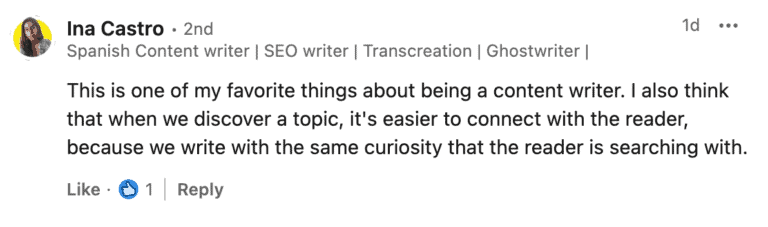
“It’s easier to connect with the reader, because we write with the same curiosity that the reader is searching with.”
That’s exactly why content writers are so effective:
They’re not writing from a pedestal. They’re writing from discovery.
They’re learning the topic at the same pace the reader wants to understand it, which makes the writing clearer, sharper, and more human.
For me, this screams this content writer is only writing “beginner” topics and not deeper content like bottom of the funnel content or even middle of the funnel content.
This is where the money lives as a freelance writer!
7. Adaptability Is the Real Superpower
Muhammad Hassan pointed out:

“It’s funny, but it also shows how much adaptability content writing requires.”
This job demands flexibility — mentally, creatively, and emotionally.
Every brief asks:
- “Can you understand this quickly?”
- “Can you make it clear?”
- “Can you write about it like you’ve been in this industry for years?”
And we can, but realize we don’t HAVE to! You can have a niche!
8. Most of What We Learn Disappears the Moment We Hit ‘Submit’
Catherine Singo summed up the entire post in one line:
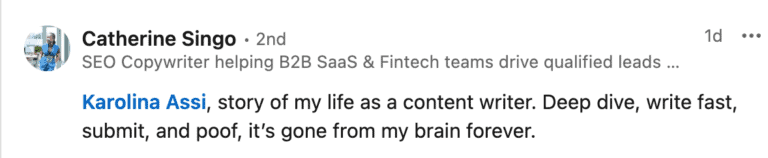
“Deep dive, write fast, submit, and poof — it’s gone from my brain forever.”
And yep. That’s exactly how it feels when you start freelance writing.
Content writers don’t retain everything because they’re not supposed to. They’re moving from topic to topic, client to client, deliverable to deliverable.
Their brains clear space for the next thing coming.
It’s part of the cycle, but it doesn’t have to be.
How to Avoid the Overwhelm: Choose a Freelance Writing Niche
So, you’ve seen “the other side” of content writing.
Do you like? Not like
If you don’t like having to spend hours researching a topic for every new client piece, then consider having a niche.
The quickest way to avoid the “learn → write → forget → repeat” trap is to find a freelance writing niche, and stick with it long enough to build real depth.
Here’s why niching helps:
1. You Stop Relearning Everything From Scratch
When you write in the same industry week after week, you’re not starting from zero anymore.
You already know:
- the terminology
- the audience
- the pain points
- the products
- the competitors
Your research time drops in half. Your confidence doubles.
That’s why I decline some client pieces if I don’t know the topic. For example, one client wanted me to write a post about Thinkific.
I’ve never used Thinkific and I didn’t have the time to spend signing up to the free tier and learning about it or watching YouTube videos about it.
I also felt it would be too superficial and not authentic.
2. You Get Better at Spotting Patterns
Every industry has its own rhythm, own structure and its own trends.
Once you stay in one lane long enough, the information sticks.
You build actual expertise — not temporary, “gone by Tuesday” expertise.
Suddenly, those rabbit holes become shorter, faster, and more intentional.
That’s why having a swipe file of latest trends and stats is super helpful when you write a client article.
3. Clients Trust You More (and Pay You More)
When you’re the “go-to” freelance writer in a niche, clients come to you already believing you’re the right person.
- You don’t need to convince anyone.
- You don’t need to prove yourself from scratch.
- You don’t need to audition with a million samples.
A writing niche positions you as the expert, even if you started out knowing nothing.
This is exactly how I started freelance writing.
Sure, you can pick a few niches to learn from but once you find a topic you like or an industry you want to learn about, then you can pick that niche and dive deep into research.
4. Your Brain Finally Gets to Rest
Instead of switching between ten topics a week, you stay in one world.
Your research becomes simpler. And when that happens, your outlines become easier. And don’t forget your writing becomes faster and your stress levels drop.
You get to show up as your best content writer self without burning out from information overload.
5. You Can Still Explore, But Without the Pressure
Choosing a writing niche doesn’t mean you stop learning altogether. It just means you stop carrying the weight of constant newness.
It suddently becomes fun to listen to a podcast about your niche topic or find some blogs that talk about it. It’s on your time and you want to learn about it for yourself!
And you can still take on interesting projects. It’s okay if you want to write outside your niche if something excites you.
I’ve mentioned that I did a short stint with Writers Access. This is a low-paying content farm but I wanted to write about something easy and that didn’t really need my brain to write it!
I ended up writing about being a mom, cooking for kids or setting up play activities.
This was easy topics and I got paid for it.
You just don’t rely on that randomness to pay your bills.
Wrapping It Up
If you want to avoid the overwhelm, burnout, and mental clutter that every content writer joked about in Karolina Assi’s comment thread, niching is your answer.
- A niche gives you clarity.
- Clarity gives you confidence.
- Confidence gives you better clients and better pay.
And the best part?
You get to write without losing your mind every time you open a new brief.
Let me know in the comments whether or not you have a writing niche or you enjoy the thrill of learning a new topic for each new client!
I’d love to hear both sides!



Leave a Reply