
When I first started freelance writing, I did what many new freelancers do.
I signed up for Guru.
Back then, Guru was one of the biggest freelance platforms around. Later, many writers moved over to Upwork, Freelancer, PeoplePerHour, and other similar sites as the freelance industry evolved.

There were thousands of projects listed. Clients were actively searching for writers and when I scrolled, all I saw were new job ads every.single.day!
This was awesome and as a brand new freelance writer, I thought this was my ticket to becoming a professional writer.
Because, at that time, I didn’t have a website yet or an audience. I certainly didn’t have a personal brand or a portfolio packed with impressive client work.
All I had to do was create a profile, browse through projects, and start applying.
At least, that’s what I thought.
If you’re interested in being a freelance writer, I don’t want you to think the ONLY places to find clients is on freelance platforms. There are soooooooooo many other places to find high-paying writing jobs that you will never need to create an Upwork profile.
I Thought Upwork Had It All
At first, having access to so many potential clients FEELS exciting. You log in and suddenly you’re surrounded by opportunities. Blog posts. Website copy. Email marketing campaigns. Product descriptions. Social media content.
It feels like work is everywhere.
For a while, that can be incredibly motivating because it gives you hope. You start imagining all the clients you’ll land and all the money you’ll make.
But after a few weeks, I started noticing something that made me pause.
Every single project had dozens of writers applying.
Sometimes hundreds.
And many of those writers were willing to work for rates that I simply couldn’t compete with.
I remember scrolling through listings and seeing projects that would take several hours to complete, only to find freelancers bidding $10, $15, or $20 for the entire assignment. Even back then, I knew those rates weren’t sustainable.
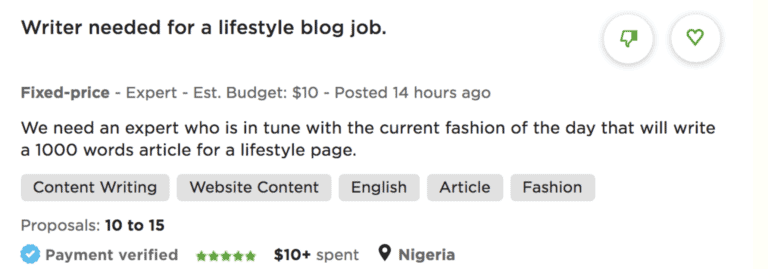
It quickly became clear that I wasn’t competing based on my writing ability. I was competing based on price.
And that means you are seen as a COMMODITY and not as a valuable collaborator.
It Felt Like a Race to the Cheapest Writer
One of the biggest lessons I learned from freelance platforms is that the cheapest freelancer often gets the attention first.
Not always. There are certainly clients who value quality. But often enough that it becomes frustrating.
Many clients on these platforms aren’t necessarily looking for the best writer for the job. They’re looking for the lowest quote that seems “good enough.” As a result, you can find yourself constantly trying to justify why you’re charging a little more than the next writer.
That’s exhausting.
You’re spending hours writing proposals, refreshing the platform, sending applications and checking for messages waiting for the gig.
Then waking up the next day and doing it all over again.
I did land some decent projects through Upwork but that’s because I reached out to the client first on LinkedIn and then they told me they were on Upwork. I didn’t mind this because I wasn’t finding clients on the platform, I was only using it to get paid. But it at least helped me build confidence and gain some experience working on that platform.
But, before I landed those clients, I was scrolling through Guru and later oDesk and it was evident that I was spending WAY TOO much time pitching and not hearing a THING back.
The math simply wasn’t mathing.
Eventually, I had a realization that changed the direction of my freelance business. I started to go to job boards and that lead me to higher paying clients.
And this is what I teach (as well as dozens of other ways to find clients) in Writeto1k.
Rather than competing with fifty other writers for every project, I started focusing on job boards and creating my own online presence. I launched a website. I started blogging. I guest posted on other sites. I created content that showcased my expertise and helped potential clients understand what I could do.
And over time, I built a successful freelance writing business.
Why Freelance Platforms Make It Hard to Build a Business
The biggest issue with relying entirely on freelance platforms like Upwork, Guru, Fiverr, or Freelancer is that you’re building your business on someone else’s platform….where they take a CUT of your PAY.
That might not seem like a big deal when you’re first getting started, but over time it can create some serious challenges.
1. You Don’t Own the Audience
When you’re finding clients through a freelance platform, the platform owns the audience.
They control the traffic and they decide which profiles get visibility and which ones don’t.
If your profile gets buried in search results, your leads can disappear overnight.
That’s very different from building your own website, email list, or LinkedIn presence. Those are assets you own and control.
A blog post you publish today could bring clients years from now but a proposal on a freelance platform might only be visible for a few hours.
2. You’re Constantly Competing on Price
One of the most frustrating parts of freelance platforms is how often they turn writing into a bidding war.
Instead of focusing on the value you bring, you’re often competing against dozens of other freelancers who may be charging significantly less….and this is discouraging for you I bet! It was for me.
I started thinking, maybe I don’t deserve more then a few dollars to write this type of content.
With this type of thinking, there no way you can raise your rates or even position yourself as the go-to expert in your niche.
Clients view you as another business person when they go to your website and toot around your portfolio and testimonials. When this happens, clients are more invested in YOU and wanting to work with YOU and aren’t focussed on price but on results you can give them.
3. The Platform Controls Your Business
When you have a profile on a freelance platform, you have no control over algorithm changes, or rule changes.
I’ve heard stories from freelancers who built their entire income around one platform only to have their account suspended or restricted unexpectedly. Suddenly, the leads stopped coming and they had no backup plan.
That’s a scary position to be in.
When your entire business depends on a single platform, you’re putting a lot of trust in a company that can change the rules at any time.
I always suggest to writers to have more than one place to house your portfolio. Place it on LinkedIn, Pinterest, your blog or on Journo.
4. It’s Hard to Build a Recognizable Brand
Most successful freelance writers eventually become known for something.
Maybe they’re SaaS writers or they specialize in email marketing.
Maybe they’re experts in finance, health, or B2B content.
But if you are on a freelance platform, it’s difficult to stand out because there are hundreds of other profiles clients can look at.
Instead, have a website and create blog posts so prospects and read what you write and see if you’re a good fit.
5. It’s a Revolving Door
Freelance platforms are often focused on finding the next project.
And then the next one.
And then the next one after that.
Suddenly, you’re stuck in this cycle of chasing work instead of building a system (like a pitching process) that works for you.
Along with pitching, there’s also networking, gathering referrals, trying out guest posting and growing your personal brand. This compounds over time.
This is how successful freelance writers are successful! They continually generate opportunities even though they may not be pitching every day.
Are Freelance Platforms Always Bad?
No.
I don’t think freelance platforms are evil, and I certainly don’t think every new freelancer should avoid them completely. I mean I even think content mills have a place for freelance writers (at times).
I mean, they can be useful in certain situations so don’t knock them off completely.
If you just need some experience applying or you are trying to fill the gap between client pieces, a freelance platform can help. They can also be useful during slow seasons when you’re looking to fill gaps in your schedule.
The problem starts when they become your entire business strategy.
I’ve seen writers spend years refreshing freelance platforms every morning.
Years!
Meanwhile, they never build a website. They never create content. They never network with people in their industry. They never develop a client acquisition system that works independently of the platform.
That’s when freelance platforms stop being a tool and start becoming a trap.
Build Something Bigger Than a Profile
Looking back, I’m grateful I started on Guru.
It taught me how to write proposals. It taught me how to communicate with clients. It taught me how competitive freelance writing can be.
But I’m even more grateful that I eventually moved beyond it. Because the goal isn’t to become the best bidder on a freelance platform.
The goal is to build a freelance business that supports your life.
- A business where clients hire you because of your expertise.
- A business where your rates aren’t determined by whoever is willing to charge the least.
- A business where you’re not refreshing freelance platforms every morning hoping someone chooses you.
Instead, you’re building a reputation that attracts the right clients to you.
And trust me, that’s a much better place to be.
Upwork Isn’t Everything
I hope you realize that Upwork isn’t EVERYTHING and it doesn’t even need to be the STARTING point.
It’s there for certain times and of course, if you tried everything go ahead and try a freelance platform. You may win at the end!
Let me know if you’ve tried any of these platforms and what your thoughts are about them.
I’d love to know!


Leave a Reply