
On LinkedIn I posted about something I’ve been noticing more and more lately: companies say they’re looking for a content writer, but then you read the job description and realize they’re actually looking for an entire marketing team.
Just…one person doing it. Can you believe those types of jobs?
The job ad starts innocently enough. They need someone to write blog posts and other long-form content. Okay, that’s a content writer.

But you keep scrolling.
They also want this person to manage social media, write email campaigns, understand SEO strategy, create landing page copy, repurpose content, interview customers, analyze performance and sometimes even create graphics.
So, are you hiring a content writer?
Or are you hiring five different marketing roles and hoping one person can somehow do all of them?
Because those are two VERY different job descriptions.
And judging by the comments on my LinkedIn post, I’m definitely not the only writer who’s noticed this shift.
What started as my little observation about content writing jobs turned into a much bigger conversation about scope creep, specialization, burnout and what companies should actually be looking for when they say they need a content writer.
And there were some interesting takes from both sides.
But First, Here’s What I’m Talking About
Almost every day I see these full-time writing jobs disguised as a flexible easy content writing job.
Here’s an example:
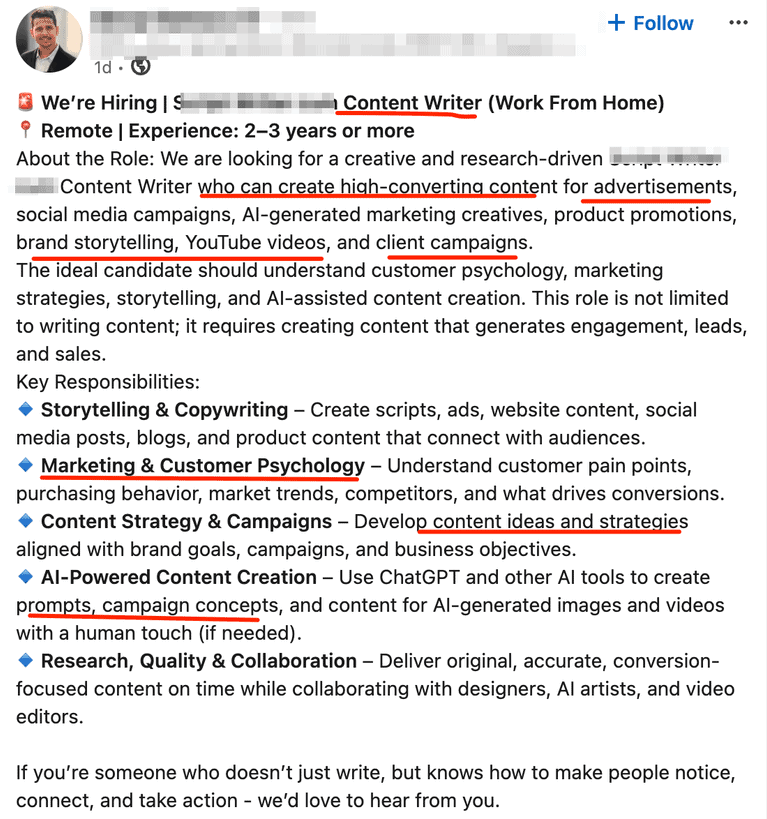
I mean this job ad wants you to create:
- ads
- social media campaigns
- AI marketing creatives (i.e. prompts for everyone to use)
- product descriptions and promotion copy
- brand storytelling: create scripts, ads, website content, social media posts, blogs, product content
- Youtube videos
- client campaigns
- Understand custimer psychology: pain points, purchasing behavior, market trends, know competitors, and what drives converstions
- Collaborates with designers, AI artits and video editors.
Whew! That was a lot.
While a content writer CAN do all of this stuff, there are tasks for different types of writers:
- Script writers
- Copywriters
- Digital marketing writers
- Social media writers
- eCommerce writers
For some reason, business owners just see a content writer as a generalist. Someone who does everything and knows how to write everything.
I don’t know about the up-and-coming content writer, but you DON’T need to know all at once how to write emails, social copy, reddit comments, LinkedIn posts, blog posts, product descriptions, ad copy or website copy.
Those are specific writing services that a writer picks from and learns the ins and out of ONE or TWO services.
For me, I learned SEO long form blog writing. Over time I learned copywriting techniques and could write marketing emails and funnels.
Now? I am learning more about LinkedIn post writing.
So, over time, I can learn more than one skill, so while this job may be for a senior level content writer, it did not state that. It also is full-time so it’s not really a freelance job either.
I hate these types of jobs and so do many other writers.
Writing Isn’t Just “Writing” Anymore
I think this is where some companies get tripped up. They see writing as the skill.
If someone can write a blog post, surely they can write an email. And if they can write an email, they can probably knock out a landing page.
Oh, and we need three LinkedIn posts this week too. Technically? Sure.
But each type of content has a completely different job as I mentioned before.
An SEO blog post might require keyword research, competitor research, SME interviews, statistics, examples, internal linking and figuring out how to make the piece useful enough that someone actually wants to read 2,000 words about B2B software.
An email campaign needs segmentation, subject lines, messaging, CTAs and sometimes testing.
LinkedIn requires a completely different voice and understanding of what gets someone to stop scrolling.
Same keyboard but very different work.
One commenter on my LinkedIn post put it well when she pointed out that even within medical writing, a clinical study document, patient education leaflet and LinkedIn post require different skills.
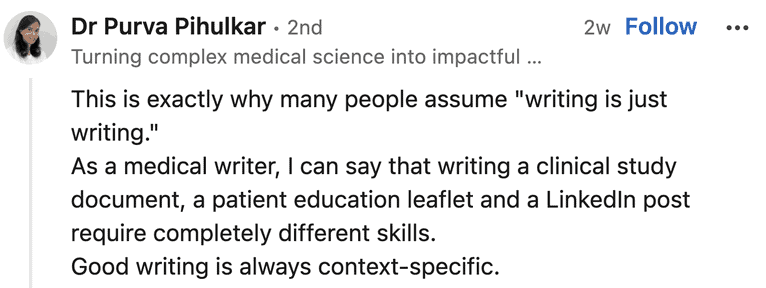
That’s exactly it.
Good writing is context-specific.
And when companies lump every type of content together because “it’s all writing,” they’re ignoring a huge part of what actually goes into producing good content.
The Job Posting Can Also Scare Away Good Writers
Amanda Ashley’s post really stood out to me because the writer said she found these job ads intimidating.
She had taken some time away from freelancing during a busy parenting season and was trying to come back to it. Then she’d see one of these postings and immediately think:
I’ll never get this job. I don’t know how to do all of this.
I can absolutely see how a newer freelance writer would feel the same way.
You start reading a job description thinking you’re applying for a writing position and suddenly you’re expected to understand SEO, email marketing, social media management, conversion copywriting, analytics, design and seventeen marketing tools you’ve never heard of.
Don’t forget to upload your portfolio and tell us why you’re passionate about our mission.
If there’s ONE THING you should take away from this post it’s this:
You don’t have to know how to do everything to be a good writer.
In fact, becoming really good at one or two valuable types of writing can make you more attractive to the right clients.
I’d rather become known as an excellent SaaS writer than be mediocre at blogging, social media management, graphic design, video editing, paid ads, email marketing and whatever else someone decides to throw into a content writer job description.
Then There’s the Scope Creep That Happens
Sometimes the job doesn’t even start this way. That’s another interesting point that came up in the comments of my LinkedIn post.
You get hired to write blog posts and everything is going great. Then someone asks:
“Could you also turn this into a few social posts?”
Sure.
It’s related to the article. No big deal.
Then it’s:
“Could you put together an email for this?”
Okay.
Then:
“We’re launching something next month. Could you help with the landing page?”
And somehow six months later you’re managing half the content calendar while still being paid based on the original agreement.
This is where freelance writers have to get comfortable with scope.
I’m all for helping clients but there’s a difference between being helpful and quietly absorbing another job into your contract.
If a client regularly needs something outside the original scope, that’s not necessarily a problem for you. If you don’t mind, then this is the perfect opportunity to renegotiate the scope.
Stay firm when clients start piling on more work. I had to do this for one client. I had previously written a deep dive on a tool I use every day.
They wanted me to write about a similar tool….but I never used it or even knew about. They wanted me to have the same level of depth to that post.
I told them that would be more work for me, i.e. learning the tool, watching the Youtube videos on it, maybe even purchasing the tool to see more features and having it become second nature to me, which could take time.
I wasn’t going to put myself through all of that because I was already extremely busy. This client approached me numerous times and I think, at the end, they let me go because of this but I was fine. I had written several wonderful posts for them that I could use to land other clients so I was okay with it.
Context Switching Is Work Too
This is one part of freelance writing I don’t think gets talked about enough.
Switching between completely different types of writing is tiring.
If I’m deep into researching a long-form SaaS article, I’m thinking about the reader, the search intent, the client’s POV, the structure, SME insights, examples and how I’m going to explain something complicated without making it sound complicated.
Then imagine stopping halfway through that process because I need to brainstorm seven Instagram captions.
Then jump over to an email sequence. Then go back to my article.
That’s five different mental modes for five different writing projects. Overkill!
Several writers commenting on my post mentioned the exhaustion that comes from constantly switching between roles, and I think that’s where companies can accidentally create a productivity problem while trying to solve a budget problem.
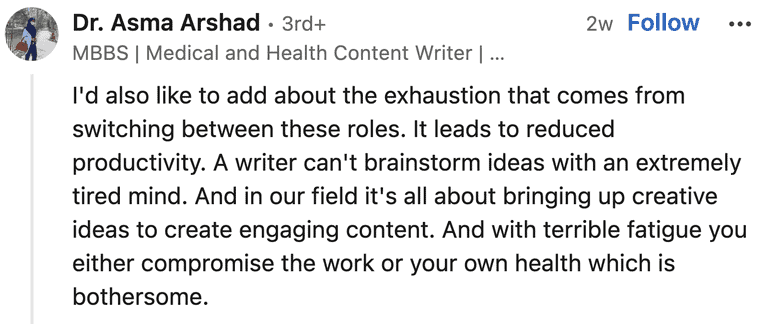
You hired one person because it seemed more efficient but that person spends the entire day changing gears.
Eventually something gives. And that’s usually it’s speed, quality or the writer themselves.
And while I don’t MIND switching context thoughts I don’t do it much in a day. This is more per days like on Mondays I’m focussed on SaaS blog writing and on Tuesdays it’s DTC emails.
For me, that’s more doable then switching three times in two hours.
The Job Posting Is Telling You Something Else
Patrice Kelly said something that I thought was interesting: when she sees these giant job descriptions, she sometimes takes it as a sign that the company doesn’t know what they need.
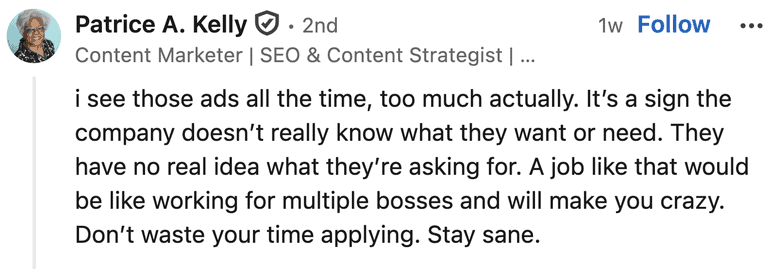
I think that’s worth paying attention to.
Because if a company needs one freelance writer to handle blogging, social, email, landing pages, customer stories, lead magnets and possibly design, what is the actual content strategy?
- Who owns it?
- Who sets priorities?
- Who approves the content?
- Who’s deciding what success looks like?
- This becomes especially important when there are multiple stakeholders.
One person approves the blog. Then another person wants changes to the landing page.
Someone hasn’t responded to your email ideas for four days.
Then everything gets approved at once and suddenly every project is urgent.
This isn’t always a writer problem. Sometimes it’s an operations problem wearing a content hat.
So be careful with businesses like these. They are typically new businesses and start ups who don’t have a dedicated content team.
Companies Might Be Better Off Building a Freelance Bench
This is why I think more companies should build a small bench of trusted freelancers rather than searching for one magical writer who can do absolutely everything.
You might have:
- A long-form SEO/content writer
- A conversion copywriter
- An email writer
- A social or LinkedIn writer
- A designer or content repurposing specialist
That doesn’t mean five people need to be working every week.
This is what a content strategist told me when we had our onbaroding call for a blog writer. She was putting together a freelance bench of technical writers, marketing/sale writers, and eCommerce writers.
Your SEO writer might produce two long-form articles this month while your copywriter handles a new landing page. Next month you might need more email support and less blog content.
As the business owner hiring a writer, you’re matching the specialist to the job instead of asking one person to constantly shapeshift.
And you start developing relationships with people who understand your brand. That’s much more valuable than repeatedly hiring writers, overwhelming them and starting the entire process over six months later.
And you know what? Writers will do better work for businesses when they know they value them and treat them as part of the team or collaboration.
If You’re a Freelance Writer, You Don’t Have to Become a One-Person Agency
I think this is the part I want newer writers to hear most. You are going to see job descriptions asking for everything.
That doesn’t mean you need to spend the next six months frantically learning every marketing skill mentioned in them.
Pick a direction and get good at it. Then add neighboring skills when they make sense for the type of clients you want.
Maybe you’re an SEO writer who learns AEO/GEO because that’s where search is moving. That’s a valuable skill businesses are needing.
I’ve been doing this for more than a decade and I still don’t try to be everything to every client.
And I think that’s actually one of the reasons I’ve been able to keep doing it this long.
The other day I saw a video from a long time copywriter who is struggling to find work. I realized it’s beacuse they rely on agency work. Their portfolio was made up of many different types of content like website pages, blog posts in different industries like healthy, HR and beauty and she also had white papers and landing page copy projects.
It was all over the place. For a business who VALUES what we do, they don’t want a writer that is a jack of all trades (even though you are seeing content writing jobs that stipulate this).
High paying businesses don’t want that. So stay away from those tpes of contnet writing jobs.
So the next time you see:
“We’re looking for a content writer…”
…and the job description requires the skills of an SEO strategist, copywriter, email marketer, social media manager, designer and content director?
Skip it!

Leave a Reply