
Soo… you’ve decided you want to become a copywriter.
Maybe you’ve been watching YouTube videos about freelancing or you’ve seen people making a full-time income writing landing pages, emails, and sales copy, and you’re thinking, I can do that.
Then you start looking at job postings. You notice every client wants to see samples of your copywriting experience.

And suddenly you’re wondering how you’re supposed to have experience before anyone will hire you.
If that’s where you’re at, you’re definitely not alone.
It’s probably one of the biggest questions I get from aspiring copywriters because everyone tells you to “build a portfolio,” but almost nobody tells you what should actually go inside it.
Should you write blog posts or create a mock Facebook ad?
Maybe it’s better to rewrite existing content like a business Home page or About page?
Should you build an entire website and showcase your copywriting that way?
The truth is, you don’t need twenty different samples before you can start landing clients. Trying to build a huge portfolio right away is one of the biggest mistakes I see beginner copywriters make. You end up spending months creating work instead of actually marketing yourself.
If I were starting my copywriting business from scratch today, I’d take a much simpler—and much smarter—approach.
Before You Write Anything, Study Successful Copywriters
Before I even talk about what you should write, I want to tell you to spend an afternoon looking at successful copywriters’ portfolios.
When I first started copywriting I spent hours going through websites from established copywriters. I wasn’t looking for words to copy—I was trying to understand why their portfolios worked.
Once I got a feel of what copywriters used for portfolio examples, I saw that each one answered the same question:
“Why should I hire you instead of another copywriter?”
That’s the question your own portfolio needs to answer. And you do that with an effective copywriter portfolio!
Don’t Try to Build an Entire Portfolio Overnight
I think one of the reasons beginners get stuck is because they hear the word portfolio and immediately picture this massive collection of work. They need a:
- homepage
- landing page
- Email sequences
- Sales pages
- Facebook ads
- Product descriptions
Before you know it, you’ve accidentally given yourself six months of unpaid work.
Here’s the thing –
Clients are hiring you because they believe you can solve their problem.
A SaaS company looking for landing page copy isn’t wondering whether you can write recipes or travel blogs. They’re looking for proof that you understand their audience and can write the type of copy they need.
I’d much rather see one exceptional portfolio piece than ten random samples that don’t connect with each other.
Start Close to the Sale
If you asked me to recommend one portfolio piece for a brand-new copywriter, I’d almost always suggest a landing page or a service page.
I know blog posts feel like the easier option because most of us have written articles before. But landing pages teach you something blog posts don’t.
They force you to think like a copywriter because that type of copy needs to earn attention right away. It also answers the question your reader is silently asking.
Every call-to-action has to move someone one step closer to saying yes. Those are the exact skills businesses are paying copywriters for.
Even better, once you understand how to write a persuasive landing page, you’ll naturally become better at writing emails, sales pages, website copy, and even blog posts because you’re learning how to guide readers toward taking action instead of simply giving them information.
Stop Thinking Like a Writer
This is probably the biggest mindset shift you’ll make.
Copywriting isn’t really about writing.
It’s about thinking.
Before I write a single headline, I want to know things like:
- Who is this business trying to help?
- What problem keeps their customers awake at night?
- Why should someone buy from them instead of a competitor?
- What’s stopping people from buying right now?
Those answers shape every sentence you write.
Without them, you’re basically guessing.
That’s why even if you’re creating a fictional portfolio piece, I still recommend treating it like a real client project.
Research competitors and read reviews.
Go ahead and browse Reddit and look through Facebook groups.
The better you understand the customer, the easier the copy becomes.
Experienced copywriters don’t just write prettier sentences.
They understand people better.
Pick the Industry You Actually Want to Write For
Here’s another thing I noticed while reviewing professional copywriting portfolios.
Most of the strongest writers weren’t trying to appeal to everyone.
They were known for something like finance, SaaS or healthcare.
They could also be known for a type of wirting like sales page writing, website copy or email funnels.
That made it much easier for potential clients to picture hiring them.
I see beginners make the opposite mistake all the time. Here’s a copywriter that has several different writing samples from totally different industries.
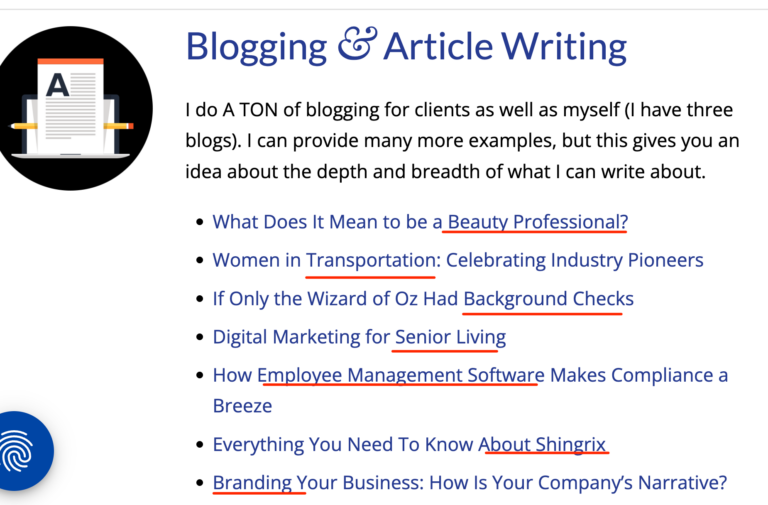
Technically, yes—they’ve built a portfolio. But what story does this copywriter tell? For me, one that doesn’t know what niche they are in which means they aren’t an expert in anything.
If your dream clients are SaaS companies, why would your portfolio be filled with local businesses you’ve invented?
Instead, create the kind of work you’d actually love getting paid to write.
If you want ecommerce clients, write ecommerce copy.
If you love working with coaches, create coaching landing pages.
Your portfolio should quietly answer one question:
“Could this person write for a business like mine?”
Borrow the Strategy—Not the Copy
I also want to mention something because I think people get nervous about studying other writers.
Looking at successful portfolios isn’t cheating.
Copying them is.
When I reviewed copywriter portfolios, I wasn’t looking for headlines to steal.
I was paying attention to how they positioned themselves.
Why did one writer lead with results instead of services?
Why did another organize their portfolio by project type?
Why did someone else include SEO traffic increases underneath each sample?
Every portfolio taught me something about displaying their testimonials or how they explained their workflow.
That’s exactly how you should approach it too.
Study the strategy and leave the words alone.
Make Your Portfolio Easy to Navigate
One thing that really stood out while I was reviewing different portfolios was how easy—or difficult—it was to actually find someone’s work.
Some writers made me click through multiple pages before I even found a sample.
Others had everything neatly organized on one page.
Guess which experience I preferred?
Potential clients are busy. They’re probably comparing your portfolio with five or ten other writers that same afternoon.
The easier you make it for someone to understand what you do, the better.
If you’re just getting started, don’t overcomplicate it. One clean portfolio page with your strongest work is more than enough.
As your business grows, you can always create separate pages for website copy, email copywriting, sales pages, or case studies.
But you don’t need all of that on day one.
Write the Copy Before You Worry About Design
I know Canva is fun.
I know website mockups look impressive.
But don’t let design become another way to procrastinate.
Clients are hiring you because of your words and not because you picked a beautiful font.
Start by writing an amazing Google Doc and reead it out loud. Then edit it by tightening your headlines and strengthen your calls-to-action.
Only after you’re proud of the writing should you think about turning it into a polished mockup.
The writing always comes first.
You Don’t Need Proof Yet—You Need Potential
You compare yourself to experienced writers who have logos from huge brands, pages of testimonials, and impressive case studies.
Of course your portfolio won’t look like theirs.
It shouldn’t.
You’re at a different stage.
Clients aren’t expecting ten years of experience. What they are looking for is proof that you understand how good copy works.
That’s why mock projects are completely acceptable when you’re first starting out.
Create a fictional business and research its audience. Then write a realistic landing page.
Show that you understand customer psychology and persuasive messaging.
Eventually, those mock projects will be replaced with real client work.
Then your real client work will replace your mock projects. Every experienced copywriter started somewhere.
One Amazing Sample Beats Ten Average Ones
I know it feels like clients expect a huge portfolio.
Most don’t.
They’re usually reading one or two pieces and asking themselves one very simple question.
“Could this person write something like this for my business?”
That’s it.
They’re not counting samples or grading you on volume.
They’re trying to imagine hiring you.
If your portfolio makes them think, This feels like something we could publish tomorrow, you’ve done your job.
I’d rather spend two weeks creating one strategic landing page than rush through ten average samples that don’t really demonstrate how I think.
Your First Portfolio Piece Won’t Be Your Last
If you’re waiting until your portfolio feels perfect, you’re going to be waiting for a very long time.
Every copywriter looks back at their early work and sees things they’d improve.
I certainly would.
That’s part of growing.
The goal is to build one portfolio item good enough to start conversations with clients.
So stop worrying about creating twenty samples.
Study successful copywriters and pay attention to how they position themselves.
Choose the niche you actually want to work in and write one outstanding landing page or service page..
Then put it in your portfolio and start pitching.
And it just starts with one sample to start being a legit copywriter!


Leave a Reply