
Content writing has changed A LOT since I first started way back in 2014.
When I landed my first freelance writing jobs, you could do pretty well if you knew how to research a topic, write a helpful 1,000-2,000-word blog post, sprinkle in the right keywords and make Google happy.
Of course, you still needed to be a good writer, but the actual writing was a huge part of what clients were paying you for.

Then AI came along and completely shook things up. Thank you AI! Not!
I actually started writing about AI and what it could mean for freelance writers back in 2023, when ChatGPT was still relatively new and writers were starting to wonder whether this was going to take all our jobs.
And I’ve kept a pretty close pulse on it ever since.
I’ve watched AI go from something companies were experimenting with to something that’s now built into practically EVERY content marketing workflow.
I’ve also watched freelance writing jobs change and seen client expectations change with the advancements.
And I’ve changed the way I approach content for my own SaaS clients because of it.
Because here’s the reality:
Anyone can open an AI tool now, type in a prompt and have 1,000 words sitting in front of them in seconds.
And if you’re trying to become a freelance writer, I know that can sound pretty scary.
You might be thinking, Why would a company pay me $500, $1,000 or more for an article when they can technically get AI to “write” one for them?
But after watching this play out for the last few years, I don’t think the opportunity for freelance writers is disappearing.
What’s valuable about a freelance writer is changing.
Putting words on a page isn’t the most valuable part anymore. Client’s want what YOU bring to those words.
And I’m seeing this more and more with the SaaS content I write, too.
That’s why I think learning how to become a better freelance content writer right now is much more than writing. So, if you don’t know what that “much more” stuff is, keep on reading!
AI Makes Content Faster — But Is It Making It Better?

I’ll be the first to say that AI seems to work good in the blogging world. I have several niche sites and AI has helped me write faster and put out content a a higher rate.
And companies know that AI can help improve speed.
According to the Content Marketing Institute’s 2025 B2B research, 81% of B2B marketers said their teams were already using generative AI tools, up from 72% the year before.
And what are they getting from it?
51% said AI resulted in fewer tedious tasks, while 45% said it created more efficient workflows.
So, yes.
AI is helping marketing teams move FASTER.
And this isn’t just marketers saying they feel more productive, either.
One study published in Science looked at 453 college-educated professionals completing professional writing tasks. The people using ChatGPT completed their work 40% faster on average.
That’s HUGE!
But while AI can help us produce content faster, that doesn’t necessarily mean companies are suddenly producing better, more valuable content.
In that same Content Marketing Institute research, only 17% of B2B marketers rated AI-generated content as excellent or very good.
Another 35% rated it only “fair.” And only 4% of B2B marketers reported having a high level of trust in generative AI outputs.
So we’re producing content faster…but we’re still questioning the quality of what we’re producing. I know I am whenever I read content online nowadays…was that written by AI?
And other people seem to be noticing this too.
A 2026 Gartner survey found that 49% of U.S. consumers believe generative AI has made the quality of content available to them WORSE.
For Gen Z and millennials, that number jumps to 57%. That’s crazy, eh?
Because the opportunity isn’t necessarily in competing with AI to see who can crank out a 2,000-word article the fastest.
AI already wins that race!
The opportunity is in everything that happens BEFORE those words make it onto the page.
- The research & interviews
- The original examples
- The statistics you use
- The first-hand experience you have
- The expert opinions from SMEs or case studies
- The angle nobody else thought of
That’s the stuff that takes time. And it’s also the stuff that can make your content worth reading.
That’s why for my blog posts, I always try to use examples from LinkedIn, or use first hand experience of things I went through to help make my writing more valuavle to you!
So while companies can absolutely use AI to speed up parts of the content creation process, I think the writers who become MORE valuable are going to be the ones who know how to use the skills below to make them more attractive to potential clients.
And that brings me to the seven skills I think content writers need now.
1. Spend More Time Researching Than Writing
When I first started freelance writing, I spent most of my time writing the first draft and final draft. I barely spent anytime researching as I would research as I wrote.
It was fine, I was getting paid and landing amazig clients.
But now? To land a good paying freelance writing job, spend 60% researching, 25% drafting and 15% editing.
You don’t need to follow this exactly, just know that as a freelance content writer RIGHT NOW, you need to spend much more time researching because that is what will help you stand out in the era of AI.
When I’m writing for a SaaS client, I don’t want to open the first three articles ranking on Google, rearrange what they said and call it a new article.
That’s not really creating anything and I’m just a collector of stats and examples…not what a high-paying freelance writer does.
Instead, I’m looking for information that gives the article something the other posts DON’T have.
This is sometimes called information gain.
Basically, what new information does your article add to the conversation? And there are four really good ways you can do this:
- Interview an expert
- Collect original data
- Analyze existing information in a new way
- Share first-hand experience
If your entire article is simply summarizing information that already exists online, you’re competing with thousands of other articles AND AI.
But when you add something original or add an SME quote, it will give value and give someone WANTING to read your client piece.
2. Get Good at Interviewing Experts

The idea of adding case studies, interviews or subject matter expertise into your content is something I’ve known for a long time and show how I do it it in my masterclass, Writing a B2B $1000 Article.
As of this year, it’s sort of mandatory to have interview skills to write B2B or SaaS content. You probably don’t need this skill for other types of writing niches like travel, entertainment, or even sports….but you know what? Even those niches would benefit from interviews from important people, don’t you think a hockey post would be more valuable if they had a quote from a hockey player?
And you don’t have to be the world’s leading expert on email marketing, cybersecurity, project management or eCommerce. That’s okay!
Your job as the writer is often to find the person who IS the expert and pull the useful information out of them.
One 30-minute interview can give you enough material for a 2,500-word article, several LinkedIn posts, a newsletter and potentially even more content.
That’s a LOT of content from one conversation. But to have all of that content from an interview, means you need to ask the right questions. Don’t ask,”What are your best tips?”
Instead, you want questions that uncover things you can’t find by Googling.
For example:
What’s the standard advice about this topic, and where does it fall apart?
Or:
What do most people get wrong about this?
Or one of my favorites:
What did you believe five years ago that you don’t believe anymore?
Now you’re getting somewhere! You’re pulling out opinions, experiences and stories that don’t already exist in 25 competing articles.
And here’s another little interviewing tip: Don’t be afraid of silence. Let the person finish their thought. If they say something surprising, ask WHY.
Then ask why again.
That’s often where you’ll find the quote or idea that makes the entire article worth reading. But how do you gain experience if you don’t have a freelance writing job?
What I would do is work on this skill with discovery calls and when you set up Zoom calls for new clients.
This is a great time to ask a few questions about their content needs, what they want the write to do or talk about and what resources do they have for you.
3. Create Your Own Data
I know –
“Original research” sounds like something a huge marketing company does with a $50,000 budget, right?
Well, at least that’s what I thought.
But that’s not true and if you don’t already know, creating original content can be easy. You could survey your LinkedIn audience or poll your newsletter subscribers.
That’s easy eh?
From that you could ask questions inside an industry community or you could even analyze responses from your client’s customers.
I recently created a survey for freelance writers. I am asking how AI is impacting their business and I’m compiling responses to write a report.
Ideally, I want to gather 100–200 responses from five to eight questions, including one or two open-ended questions that let people explain their answers.
For client pieces, you can do this too by asking things nobody is asking.
That’s where your article can become REALLY interesting.
Instead of asking:
“How important is AI to your content strategy?”
Ask:
“How many times did your team use AI to create content last month?”
See the difference?
One asks for an opinion.
The other gives you actual behavior you can analyzen and then your article isn’t repeating another company’s statistic.
You have your OWN statistic.
4. Find Original Insights Without Running a Survey
I just told you I’m surveying my audience, but what happens if you don’t have an audience OR a client doesn’t have hundreds of customers you can survey?
You can still create original research.
Take a collection of publicly available information and analyze it yourself (or use ChatGPT to do it for you by asking it simple questions you can use to make your own ideas).
You might look at:
- software reviews
- Reddit or forum discussions
- YouTube comments
- job listings
- app reviews
- customer support discussions
- social media comments
Let’s say you’re writing about email marketing platforms.
Instead of saying:
“Ease of use is important when choosing an email marketing platform.”
You could analyze 200 recent reviews from several popular email marketing platforms.
Maybe you discover:
Of the 200 reviews analyzed, 61 mentioned onboarding difficulties while only nine mentioned price.
THAT is interesting because that exact insight didn’t exist until you did the work to uncover it.
Of course, before you get excited to create a survey, make sure the client doesn’t already have this original research.
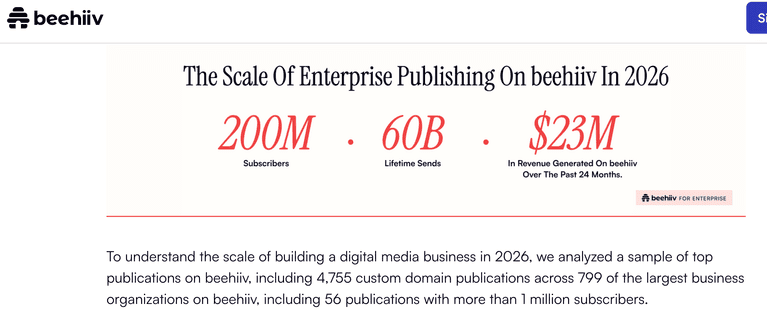
For example, for my beehiiv client, they often create reports about who is using their newsletter platform and instead of drawing from other reports, when I write for them, I can use their internal reporting.
5. Use Your Own Experience

To make writing easier for you, sometimes it’s best to use your own experience, if it makes sense and if the client allows it.
Over the years, I’ve been hired for MY subject matter expertise and for those clients, I’m encouraged to write in first person.

Now, don’t be discouraged when you see these examples. I’ve taken years to build up my SME experience. For you, you don’t have to wait that long.
You can still use your own experience in other ways.
For example, what if you’re writing about teaching someone how to create a LinkedIn post?
Create the post and document the steps. You can take screenshots to show everything and then after some time, look at the analytics to analyze.
I recently created a podcast on a not-so-nice thing that happened to me (and how I’m extremely upset by it) for my paid Substack users.
Those experiences give me things to talk about that aren’t sitting inside somebody else’s article.
So for you, approach this as saying:
Here’s what I tried. Here’s what happened. Here’s what I learned.
That alone can make your content MUCH more useful.
6. Build Your Research File BEFORE You Start Writing
One thing I used to do when I write articles for clients, is to research while I write. I mean, I still do this but I don’t do it for the majority of my post.
What happens is that writing and stopping to find a stat and writing again, disrupts your flow and it takes a LONG time to finishe the post or article.
Instead, do your thinking first. Before you write the article, create a research document (after reading over the content brief the client gives you to write the article).
I would include things like:
- Statistics and their original sources
- Expert quotes
- Screenshots
- Examples
- Competitor articles
This is also my “dump” file where I will just dump anything I need for that article.
Then create your outline.
So, think of research and writing like this:
The outline is where the thinking happens. The draft is where the typing happens.
7. Learn How to Write for Google AND AI Search
How people search online has changed changed since when I began freelance writing back in 2014.
It use to be, you go to Google and type “freelance writing” and then read a blog post about it.
Now, people are asking questions and using Googl’e AI or other AI tools to find the answers.
And this opens up the world of answer engine optimization (AEO) and generative engine optimization (GEO). This is a “new” skill all writers should know about.
But for something you can use RIGHT NOW, start writing with the answer in mind. This means answering the question quickly.
If your H2 says:
How Much Should a Freelance Writer Charge?
Don’t spend four paragraphs explaining how the freelance writing industry has evolved.
ANSWER THE QUESTION.
Then explain it and then support it.
You should give an example or two and tell the reader what to do with that information.
Your content should also be specific. Instead of writing:
“Many B2B marketers struggle with limited resources.”
Give me the number.
- Who was surveyed?
- How many people?
- When was the research conducted?
- Who conducted it?
- What exactly did they find?
Try to support your writing with these questions in mind.
So, Where SHOULD Writers Use AI?
I’m not anti-AI and I know AI is a helpful tool in my business (and should be for your business).
But I use it as an assistant. There are plenty of places where AI can speed up your workflow.
You could use it for:
- Transcribing an interview
- Summarizing a report you’re also going to read
- Brainstorming headline variations
- Helping restructure an outline you’ve already created
- Finding gaps in your argument
- Spotting repetition
- Editing awkward sentences
- Helping when you’re staring at a blank page
The source makes a useful distinction: use AI for parts of the job that don’t create the original information gain, rather than outsourcing the very things that make the article unique.
That’s pretty close to how I approach AI in my own freelance writing business.
AI can ASSIST my thinking. I don’t want it replacing my thinking.
The Freelance Writers Who Will Stand Out Aren’t Just “Writers”
I hope you don’t think this is a lot to JUST land a freelance writing job.
You can still land work without all of these skills, but if you want to make good money, it’s important to start thinking about ways to stand out when you pitch to job ads.
Sharing that you can do original content and offer uniuqe insights can be an easy way to land work.
So, tell me, are you finding that writers need these skills nowadays?
Lte me know in the comments!


Leave a Reply