
To land a freelance writing job you need more than your writing portfolio nowadays. This is something I’ve been thinking lately and I even wrote about it over on LinkedIn.
For years, the advice for new freelance writers has been pretty simple: create a few writing samples, put them in a portfolio and start pitching.
I mean this is what I’ve been teaching for over a decade.

And yes, you STILL need writing samples.
A potential client needs to see that you can actually write, understand their industry and create the type of content they’re looking for.
But after the era of AI, there’s another piece that you need to pay attention to.
Proof.
What happened after your article was published?
- Did it rank on Google or bring in traffic?
- Did other websites link to it or share it?
- Is it showing up in AI search results?
Because almost anyone can create a polished-looking article now because AI can do that in seconds.
What AI can’t hand you is a track record showing that the content you created actually did something for a business.
And that’s where freelance writers need to understand if they want to succeed RIGHT NOW and beyond.
Instead of only showing a potential client, “Here’s something I wrote,” you can start showing them:
“Here’s something I wrote—and here’s what happened because of it.”
Of course, there’s one BIG problem with this.
Most freelance writers aren’t given access to their clients’ analytics!
I certainly don’t know the traffic, conversions or leads generated by every article I’ve written over the last decade.
And when I brought this up on LinkedIn, other freelance writers pointed out the exact same thing.
So, how are you supposed to prove your writing gets results when the client never gives you the results?
Well, you might have more proof available to you than you think.
You just have to know where to look. So let’s digest this a little bit and see what you actually need and how to get it.
So, What Do You Actually Need Besides a Writing Portfolio?

So, if a portfolio filled with pretty writing samples isn’t enough anymore, what ARE clients looking for?
From all the discussions going around (and from my own peresonal experience) freelance writers need to start showing proof of what their writing can do.
And that proof doesn’t have to be some elaborate case study with charts, conversion rates and revenue numbers. It could be adding more context to the writing samples you already have.
For example, instead of saying:
I wrote this 2,000-word blog post for a B2B SaaS company.
You could say:
I wrote this 2,000-word SEO blog post targeting [keyword], and it’s currently ranking on page one of Google.
Or maybe you can show that your article:
- Ranks for its target keyword or several related keywords
- Earned backlinks from other websites
- Generated social shares or engagement
- Helped generate leads, signups or conversions
- Continues to rank months or even years after publication
You can also show proof that goes beyond numbers. Maybe the client hired you to write one article and ended up hiring you for 20 more.
Maybe they told you your draft needed almost no edits. Or an SME loved how you turned their interview into an article.
It could just be that the client came back six months later because they wanted to work with you again.
That’s proof too.
But I know for new writers, they may hear “results” and immediately think they need access to conversion rates, revenue and the client’s entire Google Analytics dashboard.
Ya’ don’t.
You’re simply trying to answer the question a potential client is probably already asking when they look at your portfolio:
“Okay, this person can write. But can their writing help my business?”
The more evidence you can give them that the answer is yes, the stronger your portfolio becomes.
But this brings up a pretty BIG problem.
How are freelance writers supposed to prove any of this when most of us don’t have access to what happens after we submit the article?
Most Freelance Writers Don’t Have Access to Client Analytics
Okay, so this all sounds great, right?
Show that your article ranks. Show the traffic it generated. Show the leads, conversions, backlinks or AI citations.
Except there’s one pretty BIG problem with that advice.
Most freelance writers don’t have access to any of this information.
Once I submit an article to a client, make my edits and get the final approval, I’m usually onto the next piece. I’m not sitting inside their Google Analytics or Search Console watching what happens to that article over the next six months.
And other writers feel the same abou this.
Senior SEO contnet writer Damilola Ajayi brought up this exact problem:
“You can write something that brings in traffic, rankings or conversions and never actually know it. So when it’s time to show proof of impact, all you have is the published piece and maybe a happy client.”
Exactly!
And Content Strategist Anmol Sachdeva agreed, saying:
“Sadly, access to performance metrics is something that most freelance writers will never get.”
He called it a “real-world problem,” and I think that’s exactly what it is.
Because I can tell writers all day long to show proof that their content performs, but where are they supposed to GET that proof?
Another content strategist pointed out another part of the problem:
“It’s rare to have access to that data from company until you use a paid tool.”
And this is why I don’t think the answer is that freelance writers suddenly need access to every client’s analytics dashboard.
We need to get a little more resourceful. In fact, SEO content writer Dhiman mentioned this in his comment. He said:
“Showing some of our relevant pieces isn’t enough anymore to draw the attention of new clients.“
So, if you feel stuck and frusteratead as these writers know thtat there’s quite a bit you can find out online yourself to show proof.
How to Find Proof Your Freelance Writing Gets Results
So, what CAN you do if your client doesn’t hand over their analytics?
Do a little digging yourself!
Start with three to five of your strongest writing samples—the ones you already send to prospects—and see what you can uncover.
You may already have some pretty impressive results sitting right there on Google without realizing it.
1. Google the Keyword Your Article Was Targeting
This is usually the first thing I would do.
If you remember the main keyword for the article, open an incognito Google window and plug it in.
Where does your article show up?
Is it on page one? Is it near the top? Does it appear for related searches too?
I recently did this for a few posts for an SEO content writer role and put this in my pitch:
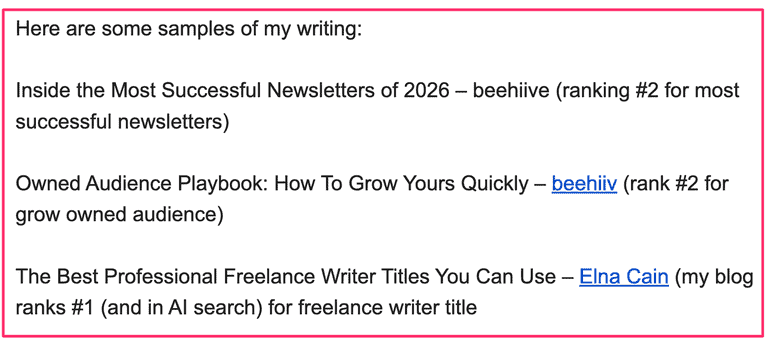
But if you’re consistently seeing your client’s article ranking well for the topic you were hired to write about, that’s something worth investigating and documenting.
Take a screenshot, save the date and add it to your proof folder.
2. Check Other Keywords Your Article Might Rank For
Google some of the long-tail keywords, questions and subtopics you covered in the article.
Most likely you’ll be typing in the whole title of your post and that’s OKAY…you can still share in your pitch that for some longtail keywords your article ranks.
Here’s an example of using most of the words in my title to find it rank #1 (after the AI citation).
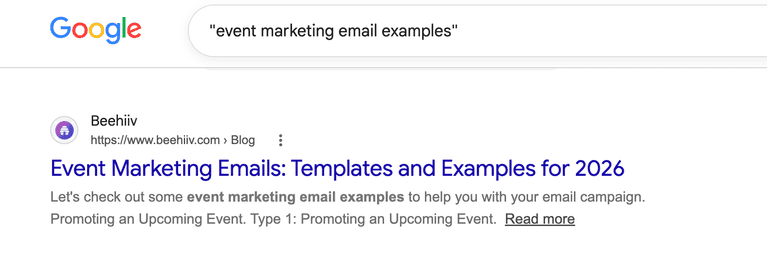
Sometimes an article ends up ranking for searches you weren’t even specifically targeting.
You can also use SEO tools if you have access to them to see what keywords a particular URL ranks for.
You might discover that one article you wrote two years ago is ranking for dozens—or even hundreds—of related keywords.
That’s much stronger information to bring to a potential client than simply handing them the URL.
3. See If Your Article Is Showing Up in AI Search
When your client post ranked on the first page of Google you were probably ecstatic. Well, nowadays, those ten ten blue links on Google don’t mean that much.
If you don’t already know, more and more people are using AI to find answers.
Ask ChatGPT a question your article answers. Try the same query in Google AI Mode or Perplexity and look at the sources they provide.
- Does your client’s article appear?
- Is something you wrote being cited?
- Is the brand you’re writing for being mentioned around the topic?
- If you find your article being cited or surfaced, screenshot it.
I plugged in a long-tail keyword associated with my title and found my GoDaddy post in the AI citation section of Google.
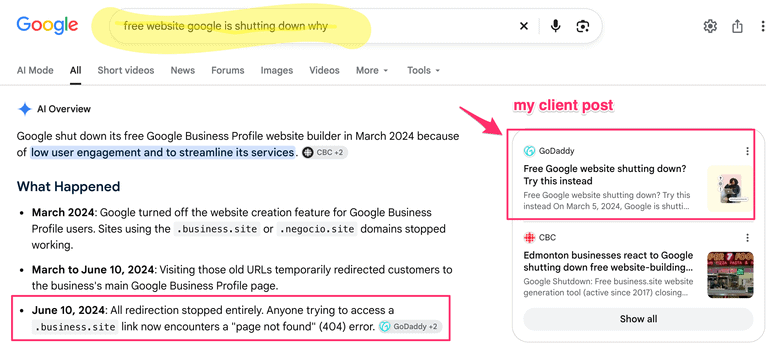
For SaaS writers especially, I think this type of proof is going to become increasingly useful as brands start caring about AEO and GEO visibility alongside traditional SEO rankings.
*If you subscribe for my paid Substack, you’ll get my AEO/GEO book and well as other books to help you with your content and making money.
4. Search for Social Proof Around the Article
Don’t forget about LinkedIn and other social platforms to show proof of your writing.
Look to see if your client share the article on LinkedIn and check out if there is any engagement. It’s a good thing to
Did their founder share it?
Did people comment on the ideas in the post?
Did someone else in the industry share the article with their audience?
Even a Google search of the article title can sometimes surface places where the content was discussed or referenced.
For me, I unfortunately didn’t pay attention to this and missed all those opportunities to take screenshots of when clients posted on social media.
So don’t be me! Investigate and take screenshots!
5. Dig Through Your Old Client Messages
I know….this can be a bit time consuming but it’s worth it to go through the 20+ thread post you have for your client (oh, is that just meeeee?)
Proof doesn’t always have to be a number so through old emails, Slack conversations, Google Doc comments or wherever you communicated with the client.
Look for comments like:
“This article is already ranking.”
“We’re seeing great traffic from this one.”
“Our team loved this.”
“This needed almost no edits.”
Or even:
“Can you write four more for us next month?”
SAVE THOSE!
A client repeatedly hiring you is proof in itself.
So is a client telling you your writing performed well, needed minimal editing or resonated with their audience.
What I like to do is when a client gloats over my writing, I use that quote for marketing purpose on social media. Here’s how I did it for LinkedIn.

6. Ask Your Client for the Results
And finally, you can simply ask for this inoformation.
You don’t need access to their entire analytics account.
If an article has been live for a few months, reach out and ask whether they have any performance data they’d be comfortable sharing with you.
Maybe it’s traffic or keyword rankings. What would be better is if they give you conversion numbers or even newsletter signups as this shows your content is highly actionable.
This is actually something copywriter Tonay T. mentioned in the comments on my LinkedIn post. She said:
“I started restructuring my contracts to include some sort of sharing of a small proof of metrics.“
I think that’s SMART.
Instead of waiting until six months after a project ends and wondering what happened to your content, start making results part of the conversation with clients.
Because your job doesn’t necessarily have to end with “Here’s the Google Doc.”
Start paying attention to what happens next.
That’s where some of the strongest proof for your freelance writing portfolio might be hiding.
Your Writing Portfolio Is Just the Starting Point
I don’t think having a professional portfolio page on your writer website isn’t going anywhere soon.
Clients still need to see that you can write, understand their audience and create content that sounds like them.
So use the suggestions in this post to help you show the immese value your WORDS have for a client.
And even if you are brand new to freelance writing, that’s okay! Pay attention to ranking and social chatter!
Over to you – are you finding you need MORE than a portfolio to land work? Share in the comments!



Leave a Reply