
A few times every year, I tell myself the exact same thing.
“I really need to get back on LinkedIn.”
So I do.

I post every day. I comment on other people’s posts. I connect with marketers and founders. I follow companies that might hire freelance writers.
For a week or two, I feel like I’ve finally figured it out.
Then life happens.
A client project gets busy. I’m focused on my blogs. I start working on a new product. Something else grabs my attention, and before I know it, LinkedIn isn’t even part of my morning anymore.
A few weeks later, I realize I haven’t logged in.
Then the cycle starts all over again.
If you’ve ever tried to build your presence on LinkedIn, you probably know exactly what I’m talking about. At first it’s exciting and you can’t wait to jump onto LinkedIn, but after a few weeks or even months, it becomes more of a chore so you stop.
But something changed in 2026.
I started going to Linkedin because I wanted to learn more about AI search, AEO, and GEO. Every day there seemed to be another conversation, another case study, or another insight I wanted to read.
Without really planning it, LinkedIn became part of my daily routine.
Since I was already spending time there, I decided I might as well be intentional with it.
Instead of scrolling for ten minutes and leaving, I started publishing every day, commenting on other people’s posts, growing my network, and treating LinkedIn like part of my freelance writing business instead of an afterthought.
I’m still in the middle of this experiment.
It’s only been a month, but the results have surprised me enough that I wanted to document everything while it’s still fresh.
So here’s exactly what happened after posting on LinkedIn every day for one month, along with what I did that made the biggest difference.
The LinkedIn Challenge Results
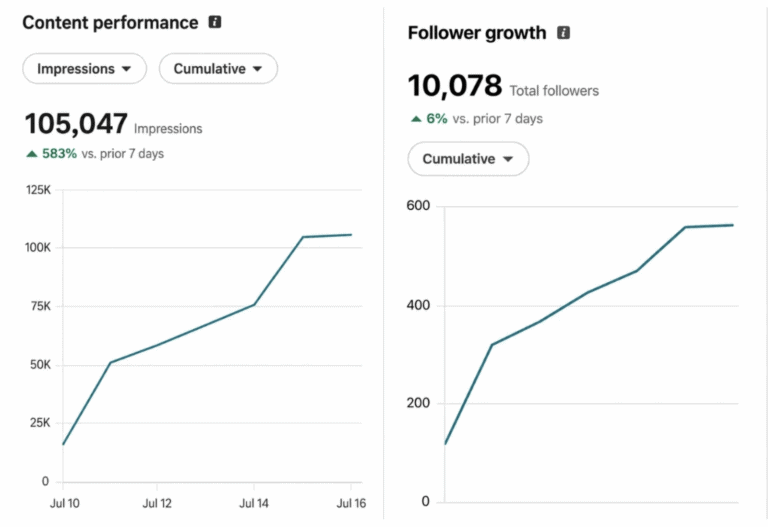
Because LinkedIn was front and center in my mind, I started posting more consistently (M-F) late June.
I scheduled as many posts as I could and over time just kept adding to the queue.
Most of the topics centered around freelancing, jobs and client work.
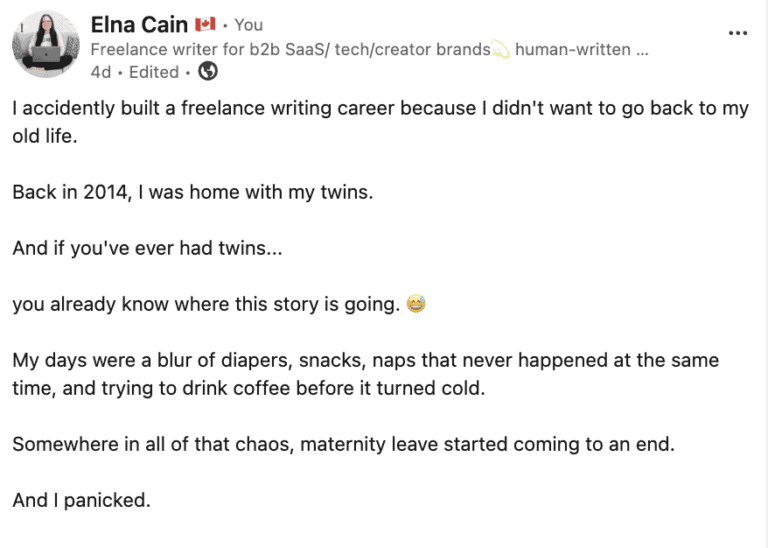
Each week, I got around the same amount of comments, impressions and connection requests. It wasn’t until I published a post about places to find writing jobs that people started sharing it, reposting it and commenting on it.
It received over 66,000 impressions that my profile grew. I gained more followers, connections, commenters and Likes.
Since then, my overall metrics have skyrocketed.
My numbers have gone down since that viral post, but overall, it’s still much higher than normal (around 20,000 impressions and a few comments and Likes previously).
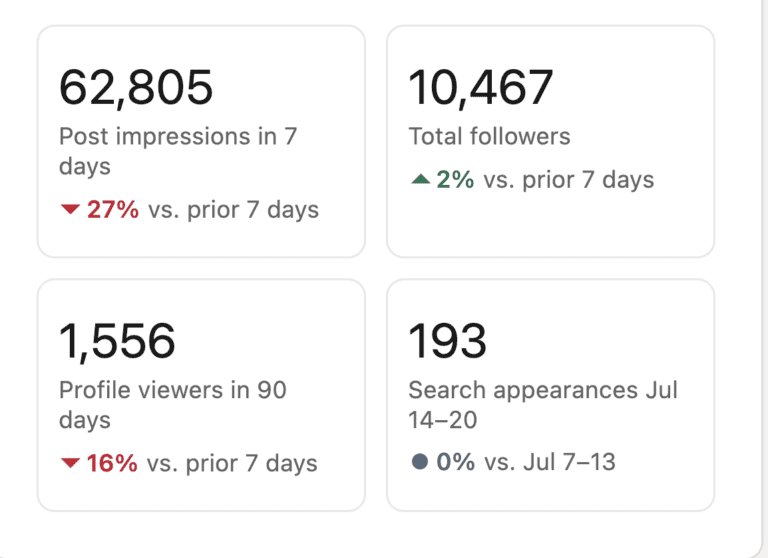
Besides posting daily M-F, I was also trying to make an effort to comment on posts and follow or connect with people who hire writers (content marketers, communications manager, CEO).
During the month I’ve also applied to several freelance writing jobs and landed some easy gigs with start up businesses.
Then, this morning in my email inbox I found a big SaaS brand with a freelance opportunity.
They said they viewed my LinkedIn profile and were impressed.
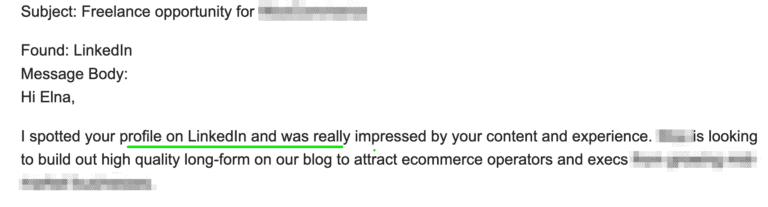
This is new but I suspect the more I keep publishing content on LinkedIn the more I’ll get emails like this from well known SaaS brands.
So how did this happen? I certainly don’t have the most followers out of other freelance writers. I know several content writers with 20,000 followers and more. I only have 10,000 followers.
I also don’t engage as much as I should on the platform as other writers do. What changed then?
Let’s look at the specific things I did on LinkedIn on TOP of writing 145 LinkedIn posts in month.
How I Gained a Freelance Writing Job Using LinkedIn
How was I able to create 145 LinkedIn posts in 30 or so days?
I will tell you that I didn’t repurpose them from emails, blog posts or Youtube videos.
Each of these posts are unique perspectives that I had.
What ended up happening was I was getting daily inspiration.
1. Gathering Topics for Daily Posting
Since I was on LinkedIn every morning, I would scroll through my feed to find posts that interested me where I could comment on them.
Other posts that interested me were once that had a take or opinion. Those posts made me want to do MORE than just comment, I ended up just writing out my own opinion or perspective on that topic.
For example, I may have seen a post on talking to your beginner self and what advice you would give.
This sparked a post idea:
“If I could go back and talk to myself in 2014, there are a few pieces of freelance writing advice I’d tell myself to ignore completely.”
So I would probably find 3-4 ideas like this and just schedule them on LinkedIn.
But I know I should be more strategic with my LinkedIn posts if I want more leads. For example, writing about data from my business or how I helped my clients in growth or AI citation is what will help bring in leads but it will also bring in less engagement I suspect.
So, over time I plan to add some of that content to my LinkedIn schedule but right now, I’m in the growth phase.
2. Tweak My Title
I like to change my LinkedIn bio title a lot.
During the month I switched it at least twice. One version had “conversion” in the title and other times just “freelance writer” in the title.
Here is where I landed on with my bio title:
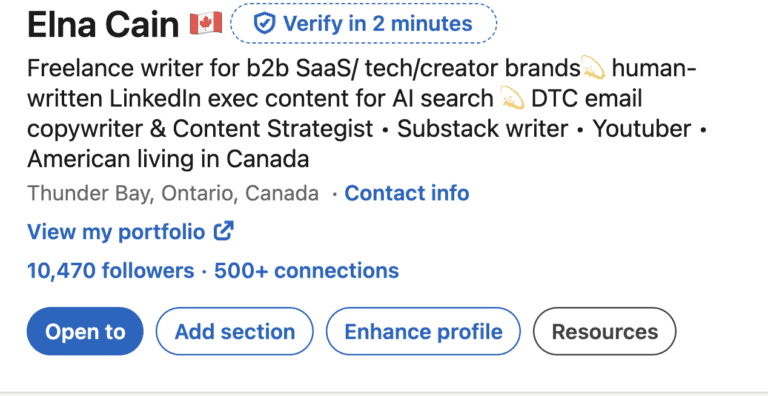
It’s okay to change up your title on a weekly basis. Find words and phrases that prospects use to find YOU.
The SaaS brand that reached out to me was actively searching on LinkedIn for a writer and found me.
3. Optimized My Experience Titles
On LinkedIn, you can build out your experience with the different writing clients or guest posts you have. When you create a new experience you can title your job role.
Once it was created I never touched it, until now.
Many of the titles for my jobs with Zapier, Wordtune or Smartbloger were “freelance writer” or “freelance content writer.”
Nothing special. So I decided to change and optimize each job title.
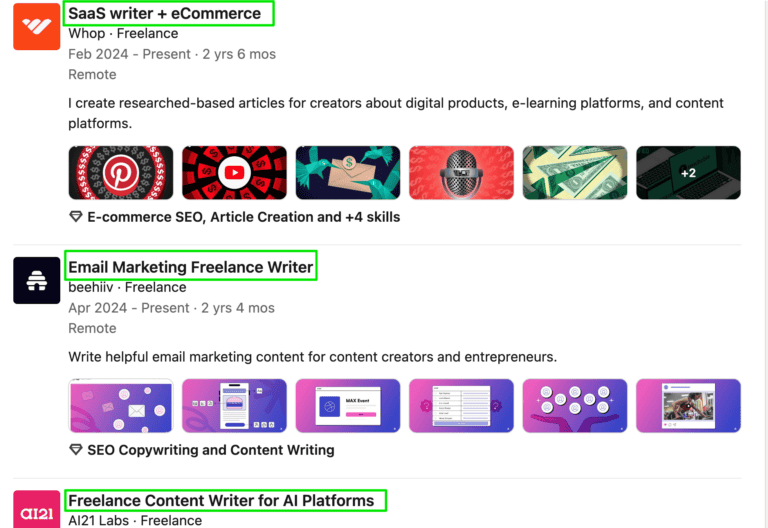
I tried to use titles that are popular or “wanted” from businesses like:
- Tech freelance writer
- Email marketing
- eCommerce
- Software freelance writer
By naming my service in different ways, I can attract more businesses because one company may search for a tech freelance writer but another one might want an eCommerce freelance writer. Both deal with tech but one is more niched than the other.
4. Updated My LinkedIn Banner + Picture
Just like my bio title, I also like to frequently change my LinkedIn banner.
I may change the copy, color or message.
For this time, I wanted to change the color, message and my profile picture.
My banner is white and I wanted it yellow. My profile pic had me wearing a yellow hoodie so I needed to find another photo of me so it didn’t clash with the yellow banner.
From there, I wanted to focus on AI citation and LinkedIn executive posts. These were “new” services I wanted to highlight and offer.
So, I made my copy on the banner reflect those changes.
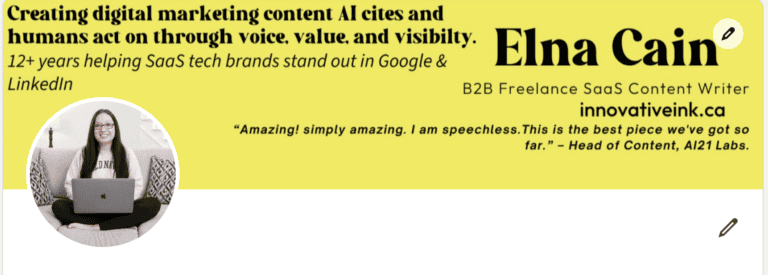
I’m not sure the copy on my banner is exactly what I want but for now it did impress a SaaS brand so that’s good to know.
For you, play around with different ways to show your experience or expertise in your niche topic. Go ahead and check out other writer LinkedIn banners to see how they used that space.
A few years ago, I noticed one writer had testimonials on their banner and I thought that was such a good idea that I added one of my best testimonials on my banner. I think this helps with prospects looking at the overall brand and what I provide.
And I know for brand new freelance writers, you won’t have all this credibility but look around and internally to try to position yourself with some credibility.
If you want to break into medical writing because you are or used to be a nurse you can use that experience and talk about that on your banner.
Or, if you’re a teacher but you want to be a travel writer you can use your knowledge of teaching younger kids and show that you can explain complicated ideas and write it for users to understand it easily.
5. Used LinkedIn Hashtags
This is the first time I’m consistently using hashtags on my posts. I don’t know if that is how I was able to get a viral post (my first time also) but it doesn’t hurt to use them.
I don’t have a system of picking or choosing which hashtag to use. I just write the ones that fit the topic I’m writing about.
If it slants more for work at home moms and productivity, then I would use those for hashtags. I have heard from other writers that they choose one general hashtag (content marketing) then one that is for a medium-sized audience (content marketing strategy) and then the final one is more niched to your topic (B2B content marketing).
I don’t know if that works better but it’s worth a try.
6. Write Articles on LinkedIn
Because my intention of being on LinkedIn was to learn more about AEO/GEO I decided to up my AI citation and write articles on LinkedIn.
During the month I wrote two articles (both on AEO/GEO) and publishing it automatically publishes on your feed.
Again, this is just another way to drum up more engagement and conversation around your brand. While I’m doing this for AEO, I’m pretty sure publishing on LinkedIn will grow your reach and over time, grow the people who check you out.
When I view my audience anylytics on LinkedIn I can see a breakdown of job titles who checked out my profile.
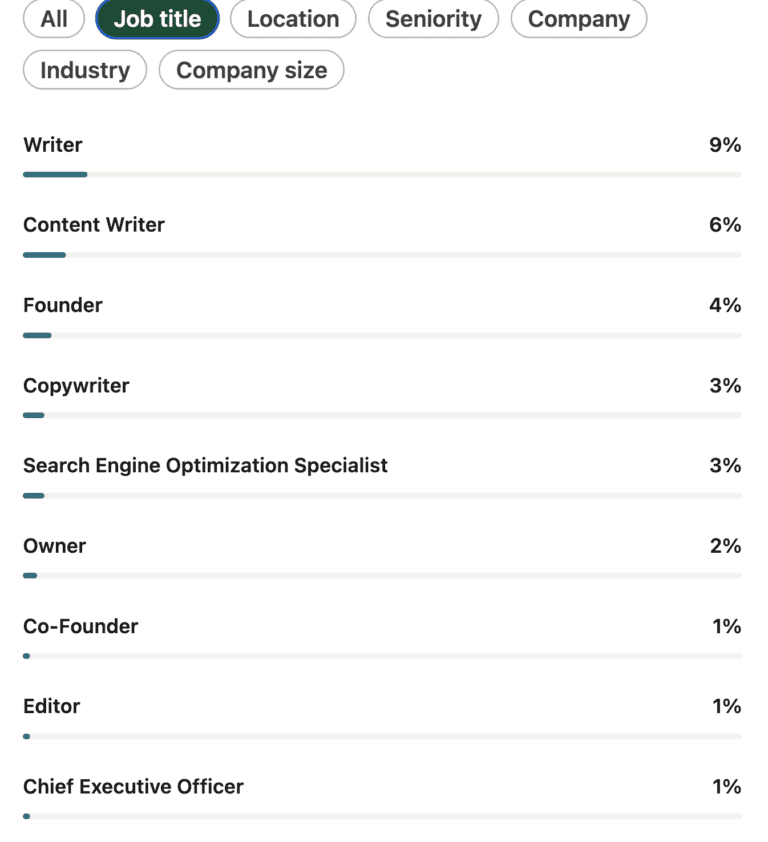
While I know writers view my profile and engage with my posts, I see founder up there. That’s a good sign that my profile is reaching broader people, especially with other job titles like, co-founder, chief executive officer or owner.
What Do I Do Now?
As you can see, it does take a lot of content and being on the platform to gain gigs. I will say I wasn’t totally strategic in what I posted and I didn’t try to connect to content marketers or people in charge of content on a regular basis.
What I did focus on was finding posts that had job ads. I would look over the job and then decide if it was worth it to apply.
Over to you – how are you using LinkedIn to find and land client work? Let me know in the comments.

Leave a Reply