
Most new writers get stuck at the same place: pitching.
I know I did when I first started a decade ago.
I scoured the internet trying to find pitch examples or tips to write a pitch that actually worked.

It feels intimidating.
You don’t know what to say.
You’re not sure if you’re sending it to the right person.
And half the time, you hit “send,” close your laptop, and immediately wonder if you’ve just embarrassed yourself.
The truth is: pitching isn’t that complicated once you have a simple, repeatable system. And over the years I’ve developed a pitching process as well as steps on crafting the perfect pitch email or message.
Today, I’m breaking down the entire process I use (and teach) so you can stop guessing and start getting replies, whether you’re pitching editors, founders, content managers, or anyone hiring writers.
Let’s walk through it step-by-step.
But before you start, make sure to check out my client booking system I’m suing right now to get more writing work!
1. Start With Your Angle, Not the Email
A pitch is a lot easier when you know the idea behind it.
I learned this the hard way.
In my first year of freelance writing, I was so eager to get clients that I sent out pitches without thinking them through.
I still remember one of the earliest pitches I sent, it was for a parenting publication, since my niche topics back in the day were natural parenting techniques.
I didn’t include a headline, didn’t explain the angle, and didn’t even outline why the topic mattered. I just said something like, “I’d love to write for you. Here are a few things I can cover.”
Cringe.
No surprise — that pitch went nowhere.
Things changed when I finally slowed down and created a simple pre-pitch process I still use today and teach to other new writers.
Before I draft a single sentence, I spend a few minutes answering:
- What specific topic am I pitching, and what’s the headline?
When I pitched SmartBlogger years ago, it wasn’t a vague idea like “blog traffic tips.” It was a specific angle with a clear outcome. That clarity is what got the editor’s attention. - Why does this angle matter right now?
Editors care about timing more than writers realize. For Beehiiv, for example, the angle tied directly into a customer problem for an audience type that was trending on social media. That relevance helped me land the writing job1 - How will this help the publication, brand, or business?
The more you anchor your pitch in their goals, the easier it is for them to say yes. Think about their customers, audience or social media presence. - What makes me the right writer for this?
When I pitched a big SaaS brand last year, I didn’t go overboard with EVERYTHING I can do to help them. I simply connected my background — years writing for SaaS companies, SEO content experience, examples in the niche — to the angle I was proposing. Content marketers don’t need your whole life story. They just want to know you can deliver this idea well.
If you can’t answer these questions, your pitch will probably not get read.
Your angle is what gives your email structure and confidence.
It shows the content marketer or founder that you understand their audience, you’ve done the thinking for them, and you’re not just firing off a mass email hoping someone bites.
2. Research the Publication or Business
This part doesn’t have to take long, but it does have to be intentional.
I didn’t always understand this.
In my early pitching days, I would skim a site for 30 seconds, glance at the About page, and assume I “knew enough.”
Those pitches got ignored.
Not because my writing was bad, but because my ideas didn’t match what the blog actually needed.
Things changed the day I spent 15 minutes doing real research before sending a pitch to a digital marketing blog.
I looked at the last month of posts, checked the tone, paid attention to the audience questions in the comments, and noticed they hadn’t published anything on a trending topic bloggers or content creators were Googling that week.
I pitched exactly that gap — and the owner responded within hours.
Since then, I’ve kept my research extremely simple and extremely focused.
You don’t need to spend an afternoon digging.
You just need a mini-checklist that helps you understand how your idea fits into their content ecosystem.
Here’s what I look for when I want to land a SaaS client:
- Their product or service
Go ahead and study not just their blog but how their product helped sellers grow. That angle will make your pitch stronger. - Their target audience
Brands always write for someone specific: SaaS founders, busy moms, small business owners, eCommerce sellers. The clearer you are about who they serve, the better your pitch lands. - The problems the audience is trying to solve
Every good pitch solves a real pain point. - The business model
If you understand what the company sells, you can create content that moves readers toward those offers. That’s what makes brands say yes. - Content they’re missing
Most companies have huge content gaps and don’t realize it. - Funnel stages they aren’t covering
A lot of brands publish “top of funnel” content (like tips and guides) but skip the middle and bottom-of-funnel pieces that actually convert. If you spot those holes, you instantly become more valuable.
3. Find the Right Contact Person
This step alone can change your entire pitching success rate.
I learned this early on when I spent weeks pitching a to GoDaddy using their generic “submissions@” inbox.
I kept wondering why no one ever replied.
Later, I found out the real editor barely checked that inbox and I think it just wasn’t working.
It was essentially a holding tank.
As soon as I found her personal email on Instagram and pitched her directly, she replied the next day.
That’s when it clicked for me:
You want the decision maker, not the catch-all inbox.
Depending on your target, this could be:
- The editor-in-chief
- The managing editor
- The deputy editor
- The content manager
- The head of marketing
- The founder (for small companies — I’ve landed multiple clients this way)
Whenever possible, I try to pitch the person who actually gives the yes.
One of my favorite examples is the SaaS brand I landed after messaging their founder on LinkedIn.
No gatekeepers. No ignored inbox.
Just a quick, human conversation that turned into a paid project within a week. Pitching the right person speeds up the entire process.
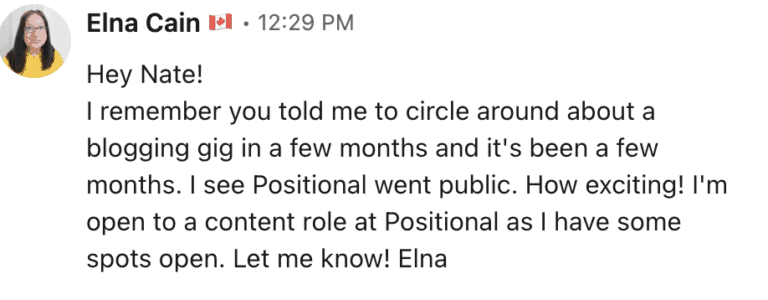
Maybe you’re thinking, “But Elna, where do I find the contact info?”
Here are some places that have worked for me.
Note: I give a lot more places and ideas in my course, Writeto1k!
- LinkedIn:
My number-one tool. I’ve found editors, content managers, and marketing leads here more times than I can count. - Twitter/X:
I once found an editor’s correct email because she casually tweeted, “Send pitches here instead.” Gold. - About or Masthead pages:
Some business blogs list their entire editorial staff, which makes it easy to choose the right name.
If you can’t find a name after a few minutes of searching, don’t panic. I would check their LinkedIn profile, find them there and send a DM instead.
Use a neutral greeting such as:
“Hi there,”
or
“Hi editorial team,”
Editors don’t reject pitches because you didn’t find their full name. They reject pitches because the idea doesn’t fit, or because it wasn’t sent to the person who actually assigns work.
So don’t overthink the salutation. Put your energy into finding the right person and making your idea relevant to them.
4. Make Your Pitch Easy to Read
Content marketers skim. They’re tired. Their inboxes are overflowing.
Your pitch needs to be clean, short, and simple.
Subject Line
Clear and specific.
Examples:
- Pitch: How Busy Parents Can Prevent Burnout
- Freelance Writer Pitch: 3 Story Ideas
- Article Pitch: Summer Home-Organization Trends
Greeting
Short. Friendly. Professional.
“Hi [Name],”
Opening Line
State your purpose quickly.
“I’d love to pitch a story idea for [publication].”
For brands:
“I’d love to help your team with content and have a topic I think will perform well for your audience.”
The Idea
Give the editor something to react to.
- One strong headline
- 1–3 sentences describing the angle
- Who it helps and why it matters now
- Optional: 2–3 bullets with sub-angles
Why You Can Write It
A few short lines that show experience—not your entire life story.
Something like:
“I’ve written for [niche] brands such as ___ and ___. My work focuses on helping readers understand ___, and I can deliver this piece quickly.”
Short. Simple. Confident.
CTA
Always close with a soft call to action:
“If this sounds like a good fit, I’d be happy to write it.”
“If you want to see more ideas, I can send another batch.”
5. Send It & Then Follow Up
One thing I started doing early in my career was to make sure to always follow up on any leads I had.
I know a lot of writers feel intimidated by this part.
You don’t want to seem pushy, you don’t want to annoy anyone, and you definitely don’t want to ruin your chances.
I used to feel the same way.
But once you’ve been pitching long enough, you realize something important:
Content managers aren’t ignoring you — they’re overwhelmed.
Sometimes they open your email on their phone while waiting in line for coffee.
Sometimes they read your first sentence, get pulled into a meeting, and forget to come back.
Sometimes they mean to respond later and never do.
Your pitch didn’t fail. It just got buried under life.
A follow-up solves that.
I learned this years ago when I pitched a big digital publication.
I didn’t hear back for a week and assumed it was a no.
But I followed up anyway, partly because I was curious, partly because I wanted closure.
They replied in under five minutes:
“Thanks for the reminder! This is great. Let’s run it!”
That response taught me more about pitching than any writing course ever could.
So here’s the rule I still use today:
Wait 5–7 days, then follow up with one simple line.
Something like:
“Hi [Name], just bumping this up in case it slipped past your inbox. Happy to send more ideas if this one isn’t the right fit.”
That’s it. No explaining, no apologizing, no rewriting your entire pitch.
You’d be shocked how many content managers reply to the follow-up and not the original email.
What’s even better is the follow-up script I share in my Writeto1k course.
A Simple Pitching System that Works
I hope you found this helpful!
Pitching doesn’t have to be challenging. Instead, make it easy with these tips.
Let me know in the comments below your pitching process!



Leave a Reply