
It’s a new year and I want some new clients!
I’m itching to get some freelance writing jobs and for this iteration, I’m going to double down and look for clients on LinkedIn.
If you want to follow me on this, I’ve been talking about it openly over on TikTok.

And I’m being transparent because I get comments or responses saying, “I want to be consistent on LinkedIn too, but I can’t get over the fear of posting.”
I get it.
Most freelance writers aren’t naturally self-promotional. It took me years to be comfortable at being self-promotional.
But, I’m hoping this post will help you faster and you don’t have to go through years to start promoting your writing and business.
Because the reality is that marketing your business on LinkedIn works.
It’s how I find clients, stay visible, and keep conversations warm throughout the year.
Over the past few years, I’ve built a presence that doesn’t rely on bragging or oversharing, just clear writing, useful insights, and consistency.
LinkedIn isn’t about “Look at me!” It’s “Here’s something helpful.” That shift makes everything easier.
And when you combine that with a long-game strategy, you stop stressing about every post and start focusing on building a steady client pipeline.
Here’s how I do that.
1. Schedule Posts In Advance
A lot of LinkedIn paralysis starts with overthinking.
You hit publish, cringe a little, and then stare at your notifications to see if anyone liked it.
Scheduling your posts removes all of that.
I schedule weeks of posts at a time, usually early in the morning, right when I’m getting my kids ready for school and not checking LinkedIn at all.
By the time I finally log in, the post has been live for at least 20 minutes and the panic has worn off.
If you’re repurposing comments, this gets even easier.
Ten comments = two weeks of posts if you schedule one per day.
LinkedIn has a native scheduling tool, and it’s easy to use.
All you do is write your post first.
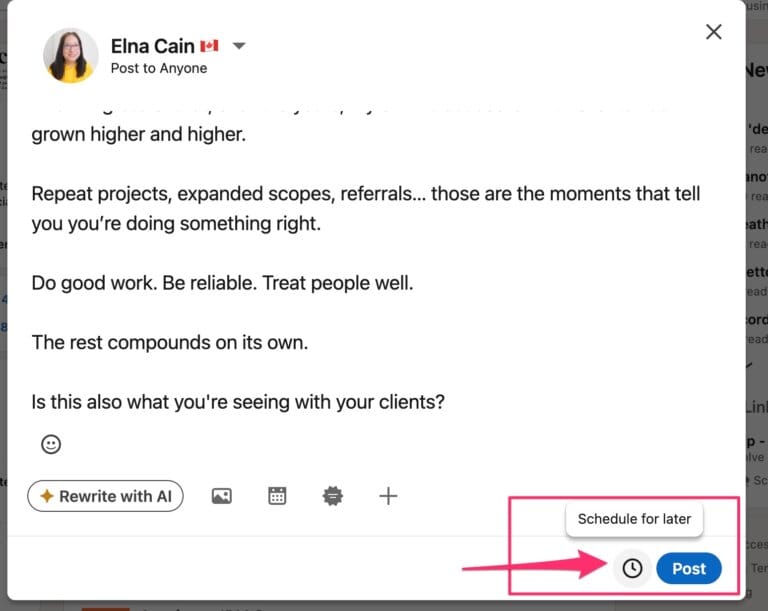
Then, instead of posting it, click on the clock symbol to, “Schedule for later.”
Then set the day and time.
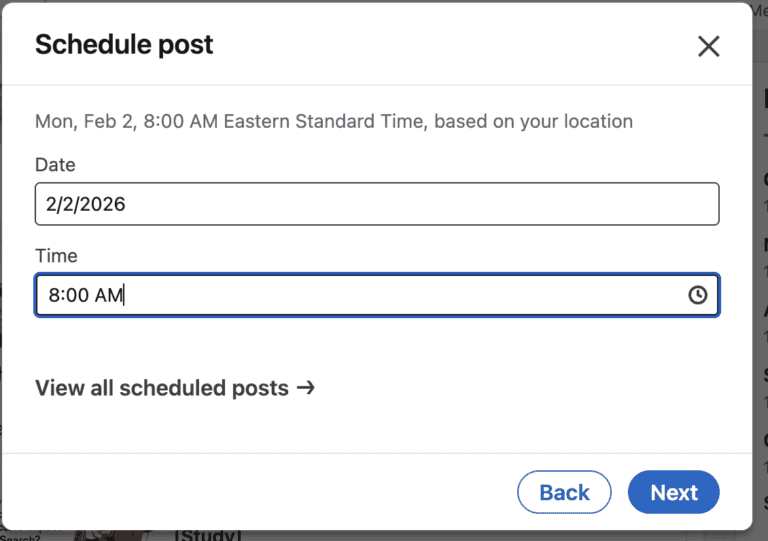
I like the schedule a post every single day and the time early in the morning to get the most reach.
Any of these will get the job done, but the real benefit is this: once your posts are scheduled, you stop obsessing over them.
2. Very Few Posts Should Be Self-Promotional
One thing I see all the time, especially with new freelance writers, is the pressure to end every post with a CTA:
“DM me for help!”
“Let’s work together!”
“Book a call!”
The intent is good, but it backfires.
I worked with someone who had great ideas but only posted every two weeks. And each of those posts ended with a strong pitch. Two problems:
- Posting every two weeks isn’t enough for people to remember who you are.
- Constant self-promotion makes people scroll past you.
LinkedIn works when you share generously.
If someone wants to work with you, they’ll click your profile. They’ll read your headline. They’ll see your featured links. You don’t have to shout.
I post self-promotional content maybe once every 10 days, and even then, it’s subtle.
A simple “As a freelance fintech writer…” is enough to remind people what I do.
These are the topics that build trust. They’re also the posts clients actually read.
3. Connect With Potential Clients
Connecting with people is one of the easiest ways to grow on LinkedIn—without pitching.
I connect with founders, marketers, content leads, and editors regularly. Not because I expect anything from them, but because more connections = more feed visibility. Even if they never hire me, their network might.
I’m active in Slack communities too. When I meet someone interesting, I connect on LinkedIn. And I never pitch. Nobody likes a “pitch slap.”
Instead, I tap the little bell icon on their profile. That way, I’m notified every time they post—and I can comment thoughtfully to stay in their orbit.
I used this same approach back when I was running sales at a marketing agency. We weren’t a big name, so staying visible meant everything. People remembered me because I showed up—not because I asked for anything.
This still works today, especially for freelancers.
4. Collaborate With Other People
Collaborations are instant visibility boosters. And, it’s easy too?
Some ways you can collaborate with others include:
- podcasts
- guest posts
- webinars
- co-written content
- expert roundups
Every collaboration taps into someone else’s audience, sometimes a much bigger one.
For example, digital marketer Lori Ballen interviewed me, which helped me get more visible.

Unlike typical LinkedIn content, collaboration posts should be a little self-promotional.
People expect it. You’re sharing something new you created or contributed to.
And clients notice.
I get messages like:
“I heard you on this podcast…”
“I read your guest article…”
This is proof that collaborations travel farther and last longer than one-off posts.
5. Reintroduce Yourself in Their DMs (Without Being Awkward)
Every so often, I’ll scroll through my LinkedIn DMs and spot a conversation that went quiet months ago.
Maybe they were hiring at the time.
Maybe they weren’t ready.
Maybe life just happened.
Either way, those quiet threads are opportunities.
Reaching back out doesn’t need to feel pushy. I treat it like reintroducing myself at a networking event:
- A short message.
- A friendly tone.
- Zero assumptions.
Something like:
“Hey! We connected a while back and I noticed we never got the chance to continue our conversation. I’d love to reconnect and see what you’re working on this year.”
This works because people forget, even the ones who liked you.
A light reintroduction puts you back on their radar without feeling salesy.
And more often than not, they’ll reply with an update, a new initiative, or a content need they didn’t have before.
It’s a small habit, but it’s one of the easiest ways to restart warm relationships and open the door to future client work.
6. Update Your LinkedIn Title With Relevant Terms
Your LinkedIn headline is one of the first things potential clients see, and one of the easiest places to stay current with what’s happening in the industry.
I update mine regularly because the terms clients search for shift fast.
For example, I recently added “AEO & GEO” to my headline.
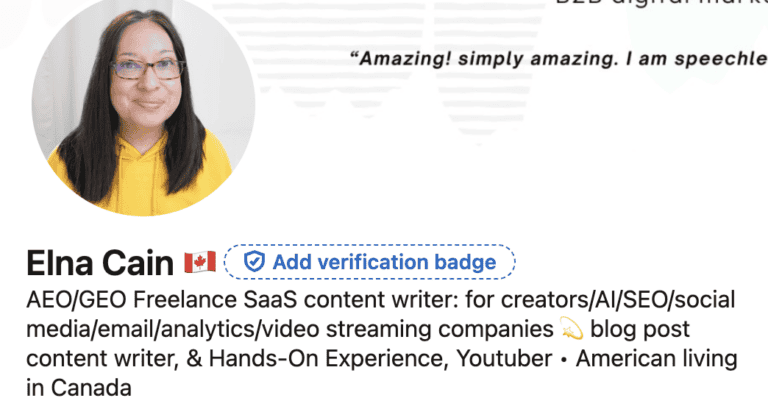
These are the conversations marketers, founders, and content leads are having right now. If they’re searching for writers who understand AI-driven search, I want to show up.
You don’t have to overhaul your headline every month, but small updates help you stay discoverable.
Add emerging terms in your niche.
Clarify your specialty. Include the types of content you create.
Clients scroll fast when checking out your headline so it should tell them exactly what you do and how current your knowledge is.
A strong, relevant headline makes you easier to find, easier to remember, and easier to hire.
7. A Long-Game Strategy to Avoid the Hard Sell
Most writers don’t enjoy the hard sell. I don’t enjoy doing it. I don’t enjoy receiving it.
And the good news? You don’t need it,vnot anymore.
Buyers today are paying attention to:
- relationships
- mutual connections
- warm introductions
- consistent presence
- referrals
- people they genuinely like
The loudest marketers aren’t winning. The most useful ones are.
And that’s great for writers!
It’s easy to connect with people on LinkedIn and comment on their posts and then warmly introduce yourself.
No harsh pitching or desparate DMs.
If you show up with good information, a helpful voice, and a clear specialty, clients will come to you.
It’s how most of my client work happens now, almost entirely inbound.
And LinkedIn is the one platform where all three compound over time.
Using LinkedIn to Find Writing Jobs
There ya go!
This is how I’m using LinkedIn to find clients in 2026.
Let me know in the comments what you are doing on LinkedIn to find freelance writing jobs!
And, if you need more help in finding clients and making money writing, check out my program, Writeto1k!



Leave a Reply