
When I first started freelance writing, there was room for us…. but now?
It’s a crowded arena.
If you scroll through LinkedIn for more than ten seconds, you’ll see a “Need a freelance writer?” post with dozens, sometimes hundreds, of writers dropping links to their portfolios.

It’s overwhelming.
It’s noisy.
And it’s easy to wonder: How does a content writer stand out anymore?
But standing out isn’t about being louder.
It’s about being memorable, consistent, and clear in your message, especially in 2026, when every platform has its own rhythm and algorithm to navigate.
So, let’s look at how you – the freelance writer, copywriter or content writer – can show up online in a way that resonates with the right clients.
Getting Started Without Overthinking Everything
You’ve probably heard people say, “Pick one platform and stick to it.”
But with how fast things change I don’t think that advice holds up anymore.
Just look at X (formerly Twitter). It’s not the same platform it was five years ago. Or three years ago. Or last year.
Here’s what works better:
Choose one primary platform for your marketing efforts, and one secondary platform to network and grow your brand.
Your primary platform is wherever your message tends to land best.
Your secondary platform is where you repurpose content in a format that fits.
For me, my workflow looks like this:
- My posts are written for LinkedIn first.
- I can then take the idea and make a post on X that’s similar
- I can use ChatGPT to help me come up with an email topic and humanize it to sound like me.
- These posts get scheduled
It’s not a copy-and-paste strategy.
Each platform has its own vibe, so your content needs small adjustments.
But this workflow gets your message working harder without doubling your workload.
Don’t Forget to Promote Yourself (Without Feeling “Cringe”)
A lot of freelancers struggle with this.
- You show up.
- You post helpful advice.
- You share your experiences.
But you never actually tell people what you do.
If you never talk about your services, people may know your name… but they won’t hire you.
Here’s what a balanced approach looks like:
- Share a monthly re-introduction with a photo (if your network is growing)
- Mention upcoming availability if your content schedule opens
- Talk about free resources to get people onto your email list
- Share a recent project or client win (even small ones)
Self-promotion doesn’t have to feel like shouting into a room.
Think of it like someone at a conference turning to you and asking:
“So what do you do?”
You’re answering politely, not pitching aggressively.
Freelancers Who Stand Out Well Today
Some freelance writers appear everywhere, not because they’re louder than everyone else, but because they’ve built a consistent message around who they are.
I know for me, it’s taken me years and years to be seen as the “go-to” for freelancing!
So, if you’re at the first stage of your freelance writing business, know that if you are consistent, it will grow and you WILL stand out!
Here are a few real freelance writers doing this well:
Kat Boogaard is relatable, funny, and extremely consistent and one I admire from the distance!
Kat’s LinkedIn posts about the everyday realities of being a freelance writer.
They’re short, funny, and speak to clients and writers. Her humor is a huge part of her brand.
Here’s an example of what we don’t say on the outside, but it’s something all freelancers think about on the inside!
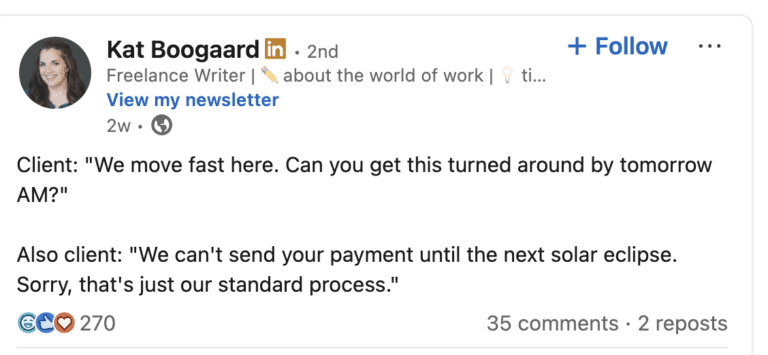
This relatability is memorable, and it creates engagement.
And engagement brings visibility. And visibility? That brings clients.
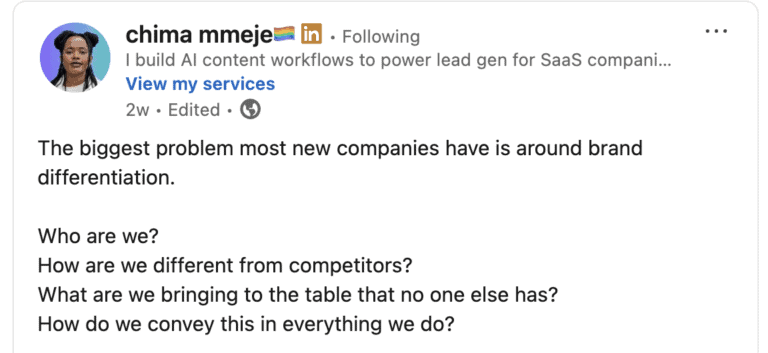
Chima Mmeje, is known for expertise and and one freelancer I see everywhere!
Chima has built her reputation on SEO and SaaS writing.
She openly shares insights about what she’s doing and current news trends.
When she posts, you immediately know it’s her, because her message stays consistent.
Kaleigh Moore has been on my rader for a decade!
Why? Becuase she clean messaging + strong thought leadership that I love reading about.
Kaleigh uses her platform to talk about what’s affecting freelancers right now from AI to healthcare to taxes and more.
Her posts aren’t flashy, they’re steady, helpful, and smart.
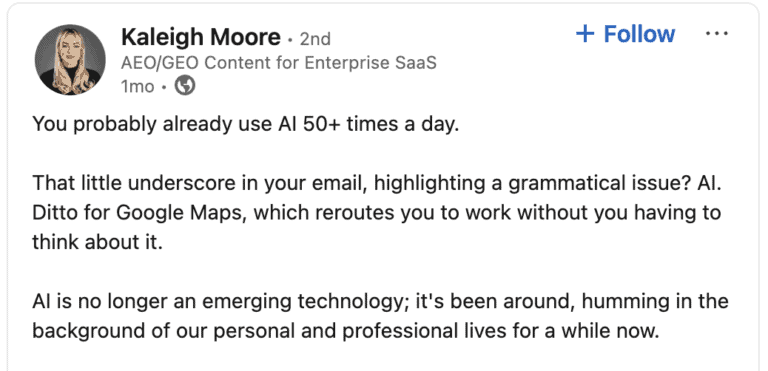
That consistency makes her unforgettable.
These freelancers don’t “go viral.”
They show up, share value, and stick to their message.
That’s the real advantage.
What “Standing Out” Actually Means for Freelancers
Social media is crowded with “thought leaders.” Some insightful. Some… not so much.
But the reason they stand out is simple:
- They show up with a clear message
- They repeat that message
- They become known for something specific
You don’t have to be the strategist behind all your client’s work to share valuable insights.
For example, I don’t publish the strategy behind my client articles.
But I do talk about my digital marketing business or my email list strategies as a business owner.
And that helps me be known for talking about the tools, processes, and systems I use to run my businesses.
- I talk about automation.
- I talk about content workflows.
- I talk about systems that remove friction from my day.
- I also sprinkle in home life and being a mom to twin TEENS
Clients see this as a sign that I’m well-versed in the lastest tools, that I’m on social media and that I’m also running a digital marketing business.
That alone helps me stand out.
You can do the same.
The Four Types of Expert Content Every Freelance Writer Can Create
Once you decide what you want to be known for, the next step is turning that into content people remember.
The easiest way to do that is to rely on a few repeatable content types. These are the ones that highlight your expertise, show how you work, and make your advice feel trustworthy.
When you use them consistently, your message becomes clearer, your authority grows faster, and clients start to associate you with the exact skills you want to be hired for.
1. Curated Insights
This is the easiest content for freelance writers starting out.
Find a post you love and leave your perspective in a comment. Then expand it into your own post.
Here’s how Amy Davis does it on LinkedIn.
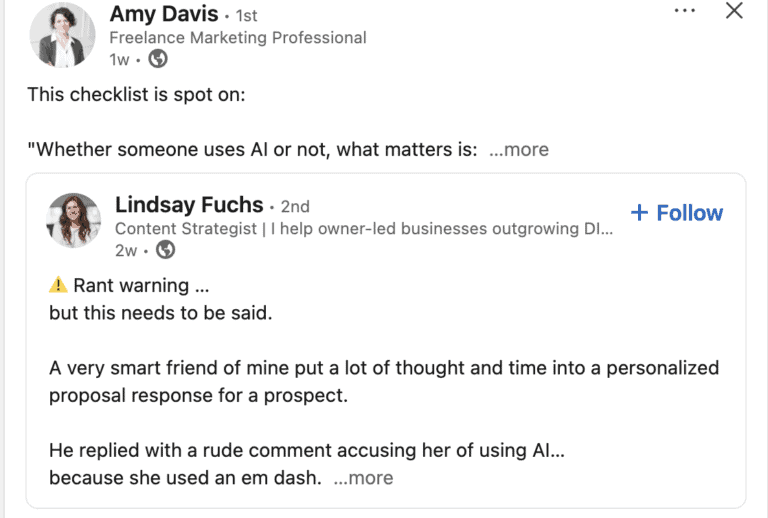
This works because you’re adding to a conversation, not reinventing the wheel.
If you’re stuck on what to say, try adding your own experience:
Add Your Own Experience
One of the simplest ways to make your content feel real is to pull from moments you’ve actually lived.
It doesn’t have to be a big story, just a small win, a mistake you made, or something you learned when you tried a strategy yourself.
This is what I do when I write my intro my LinkedIn posts.
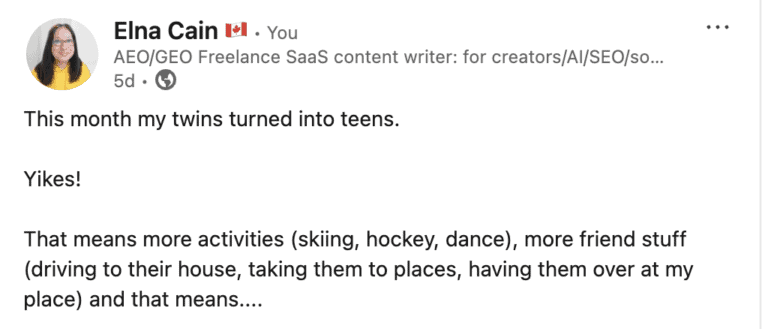
These tiny details make your advice more relatable and show people you’re not speaking in theory.
Keep it short and focused.
Two or three sentences is enough to explain what happened and what changed because of it.
When you share these everyday moments, your content feels more trustworthy, and people get a clearer sense of how you think and work.
2. Break the Idea Down Even Further
If the original post makes a big, sweeping point, your job is to make it easier to follow.
Think in terms of one small tip, one step, or one takeaway someone can apply right away.
Breaking it down makes the idea feel more approachable, especially for newer writers who are still figuring things out.
Keep it straightforward. Instead of repeating the whole concept, give readers the one part that matters most and explain it in plain language.
This turns a broad idea into something useful, and it shows you know how to simplify information without losing the value.
3. Bring a Beginner-Friendly Angle
When you’re responding to a bigger idea, remember that not everyone reading your post is at the same stage.
Take the concept and explain it in plain language so newer writers can follow along without feeling overwhelmed.
Simple, clear writing is often the most helpful, and the most memorable.
Focus on what someone would need to know if they were hearing the idea for the first time.
Remove jargon, break it into one or two steps, and share the “why it matters” in a single sentence.
Clarity always gets attention, and it quietly positions you as someone who can teach as well as do.
4. Apply It to Your Niche
When you find an idea worth expanding, make it specific to the niche you want to be known for.
Take the concept and show how it plays out in SaaS, eCommerce, parenting, health, or any industry you write in.
This helps your audience picture the advice in a real context instead of trying to translate it themselves.
Keeping it niche-focused also strengthens your authority.
Clients can instantly see that you understand their space, their challenges, and the type of content they need.
One simple example tied to your niche can do more for your positioning than a long, general explanation.
Turn Your Comment Into a Story
Start with a moment that challenged you or taught you something, those are the stories readers remember.
It could be a tough client conversation, a project you underestimated, or a small shift that made your work easier.
These moments give your content a human edge and help people understand how you think.
Keep it simple and tie it back to a clear takeaway.
You don’t need long backstory or dramatic details, just the moment, what it taught you, and why it matters to the reader.
Your voice is what makes the content stick, and these small snapshots show exactly why your perspective is worth listening to.
2. Personal Experiences
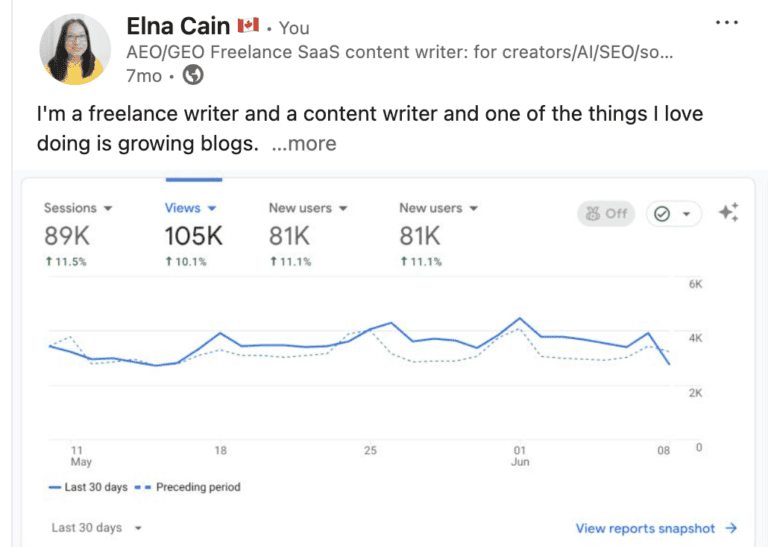
LinnkedIn is known for dumping life stories or irrlevant ideas to connect to your ideas.
But you don’t have to do that. Instead, be genuine and authentic when you share your personal experiences, instead of using viral tactics.
The right stories make people pay attention because they feel real and grounded.
They help your audience understand why your perspective matters without you ever having to say, “I’m an expert.”
Here are a few simple ways to do that:
- Pick moments, not milestones: Instead of sharing your whole journey, choose one small moment like a client win, a tough lesson, a mistake, or a turning point. These are easier to write and more relatable to readers who are still finding their footing.
- Tie the story back to a clear takeaway: Every story should end with a point: a reminder, a lesson, or a shift in thinking. That’s what makes it valuable instead of just personal.
- Use stories to support your niche: If you want to be known for SaaS content, share a behind-the-scenes detail from a SaaS project. If you want to attract new freelance writers, talk about something you learned early on. Align the story with the authority you’re trying to build.
When you choose your stories carefully, your content feels human and relatable but still focused and authoritative.
It shows people exactly what you stand for, and that’s what helps clients remember you.
3. Educational Content
This is your “how-to” category and is one of the easiest ways to show you know what you’re doing.
Clients love this kind of content because it removes guesswork.
It shows them how you think, how you work, and how you’d fit into their team long before they ever reach out.
Think in terms of:
• tutorials – short, step-by-step walkthroughs of a task you do often
• workflows – the exact process you follow to write, research, pitch, or plan
• screenshots – behind-the-scenes proof that you actually use the tools you talk about
• carousels – simple visuals that break down a concept cleanly
• quick demos – a mini “before and after,” a content fix, or a quick rewrite example
If you’re a designer, copywriter, strategist, or SaaS writer, this type of content builds massive trust because it shows your thinking in real time.
Clients can see your clarity, your logic, and your approach—things that are hard to convey in a portfolio alone.
4. Opinionated Content
The hardest posts to do well, but the most powerful are your opinion-based ones.
These are the posts that:
• attract the most engagement
• show confidence in your expertise
• position you as a leader in your niche
• spark real, thoughtful conversations
But they also require balance.
One strong opinion post a week can build serious momentum.
Ten hot takes a day? That’s when your authority starts to slip and your audience tunes out.
Here’s how to get the most out of them:
Pick opinions you can support with real experience.
Your strongest takes will come from moments you’ve lived through like client issues, writing challenges, marketing lessons, or industry changes you’ve adapted to.
Make a point, then back it with proof.
Share a quick example, a personal story, or a result that shows why your opinion matters.
Use opinions to reinforce your niche.
If you write for SaaS, talk about where SaaS content is heading. If you focus on email marketing, share what people are still doing wrong with newsletters.
When you use opinions strategically, they become a cornerstone of your presence.
They help people remember your voice, understand your values, and trust your expertise, all without posting more than you need to.
The Entire Point of Standing Out
It’s not about going viral.
It’s not about shouting the loudest.
It’s about being memorable.
So, when a potential client is ready to hire a freelance writer or copywriter, your name is the one they already know.
Because in this industry, discovery matters just as much as doing excellent work. Let that sink in, it’s the truth nowadays.
Building a strong brand is just as important (or even the MOST important) when starting freelance writnig.
And that means you need to stay consistent and visible online.
Clients WILL come.


Leave a Reply